
THE CROCODILE OF SONAPANI
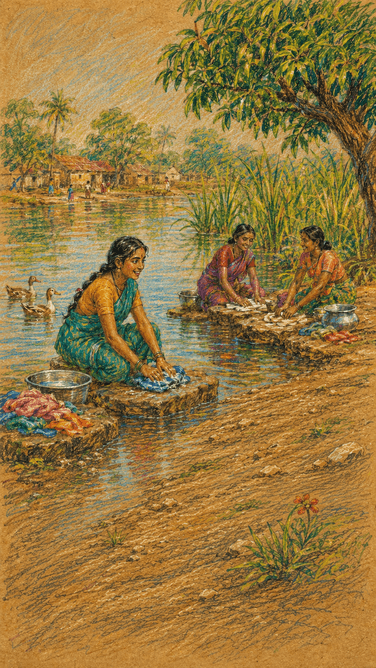
In the village of Barkuli there was a large pond; the villagers called it Sonapani. The pond usually had crystal clear water, except on rainy days. In the pond, there lived a crocodile. His name was Bhola.
For eleven years he gave nobody any trouble. He ate ducks, fish, and crabs, and he slept in the mud. The washer-women did their washing three feet from his nose and thought nothing of it.
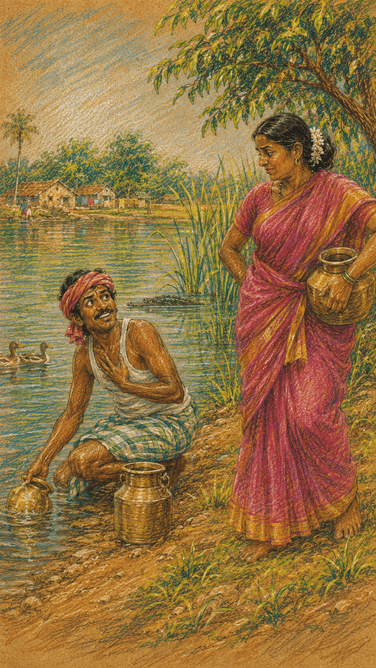
Then one hot morning, Ghisu the milkman came down to fill his cans, and Aunt Kamala on the bank asked him whether he put water in his milk.
"Never in my life, sister," said Ghisu. "Not one drop."
Before Kamala could react to Ghisu’s lie, the crocodile came out of the pond, took Ghisu by the leg, and pulled him under, and the water closed over the top of them both. The milk cans rolled down the bank and lay there in the mud.
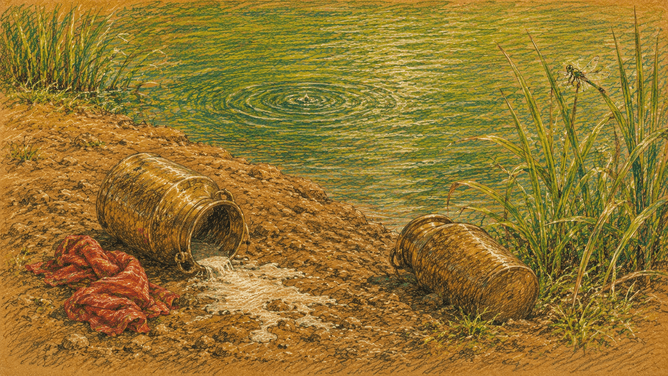
That was the end of Ghisu.
Everybody said it was bad luck, and everybody went on saying so until Tuesday. On Tuesday, Uncle Sunil stood in the same spot and said to his lender that he had paid back the loan to him, when in fact he had not paid back a thing. The crocodile came out of the water again, and it was a tragic end for Uncle Sunil. After that, nobody said anything about bad luck.
The rule was not complicated. Bhola ate liars.
He did not eat thieves. The boys stole guavas by the water every evening and grew fat doing it, and he never so much as looked at them. He did not eat rude people either, or Old Manas, who spat paan on the temple steps each morning and blamed the wind. Only liars — and only if the lie was told close enough to the pond for a crocodile to hear it.
The first man to change his whole life was Sattu the tailor, who had been standing right there when Uncle Sunil went under.
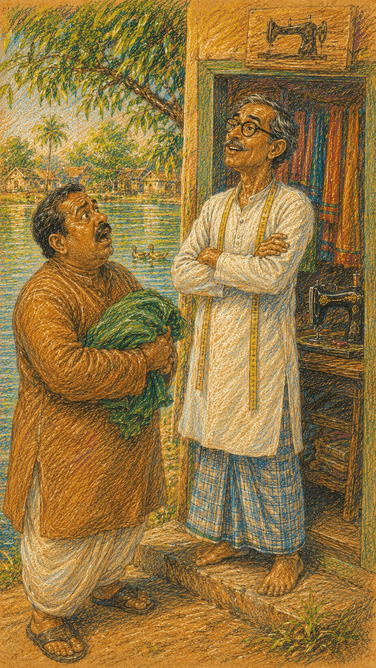
Now, for nineteen years Sattu had his shop near the edge of the pond, and he told every customer the same thing.
"Ready by Thursday, brother. Absolutely Thursday".
He had never once meant it, and everybody knew he had never once meant it, and that was simply how the shop worked.
But that was before. The next morning he stood in his doorway with the pond glittering behind him, and he looked his customer in the eye, and he said: "I will start it when I feel like starting it. And I do not feel like it."
The customer was shocked. He was also, for the first time in nineteen years, correctly informed.
He told everyone he met, and they told everyone they met, and by the end of the month, half of Barkuli had carried its cloth to the next village, where there was a tailor who would still promise them things. So Sattu went to the headman and said the crocodile was ruining his business.
The headman agreed that this was serious, and he called a meeting of the whole village to decide what should be done about Bhola. And because every meeting in Barkuli for two hundred years had been held on the flat stones at the edge of the pond, that is where they held this one too.
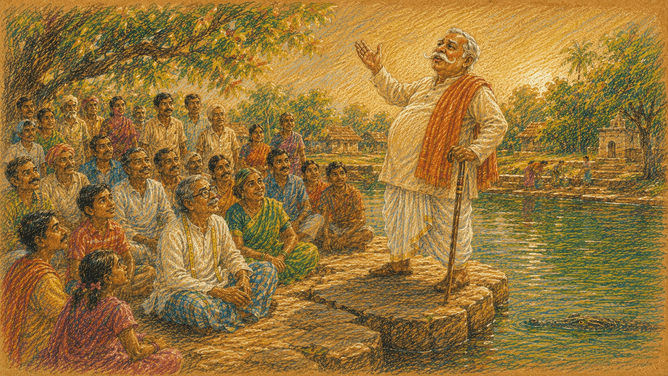
The headman stood up on the flat stones with everybody watching. He said his only concern was the good of the village, and that it had nothing whatever to do with the money he took from the fishing rights. He was still talking when the crocodile took him.
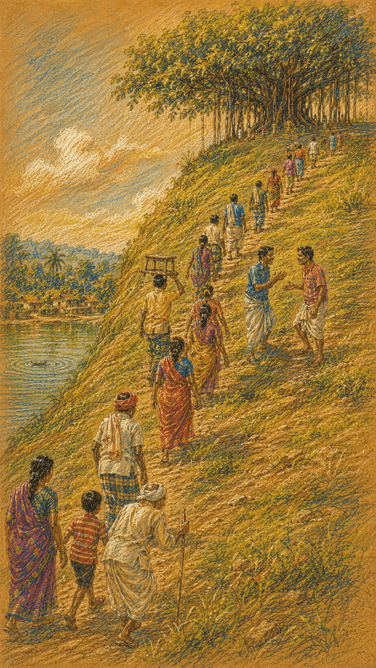
The meeting ended immediately, but an unspoken rule was adopted by everyone. Barkuli moved uphill.
Not the houses — the talking. If you wanted to tell a lie, you had to climb two hundred feet up the slope first, where the crocodile could not hear you. And since nobody in Barkuli could get through a morning without a lie or two, everybody climbed.
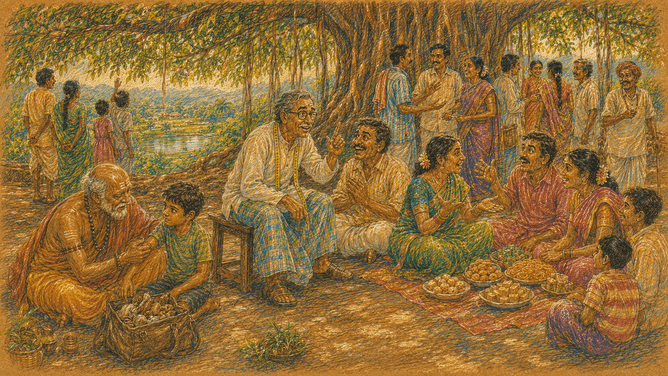
Marriage talks were the strangest of all, because the two families had to praise their own son or daughter. The vaidya moved up beside the banyan tree and went straight back to telling children that it would not hurt at all. Sattu carried a stool up and set it next to him and began promising Thursday again, and his business recovered beautifully.
But the washing still had to be done at the pond, because the pond was where the water was. So every morning the women of Barkuli went down the hill with their bundles, and they took the little ones along with them, and they sat on the stones and slapped the clothes and did not talk, because down there it was not safe to talk.
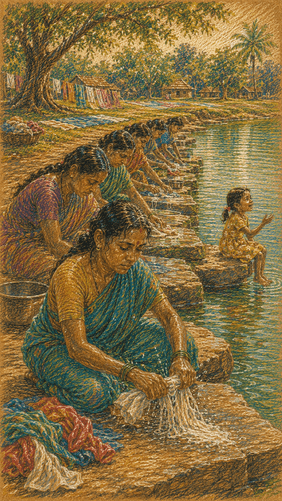
And that is how Rukku came to be sitting at the edge of the water with her feet in it, which the entire village agreed was completely mad.
Rukku was seven. She was not brave. She had simply never told a lie in her life — not because she was good, but because she had never once been able to see the point of one. So while her mother beat the washing, Rukku dangled her feet in Sonapani and told the crocodile the news, and Bhola, who had not eaten in a very long time, listened the way a hungry man listens to somebody describing food.
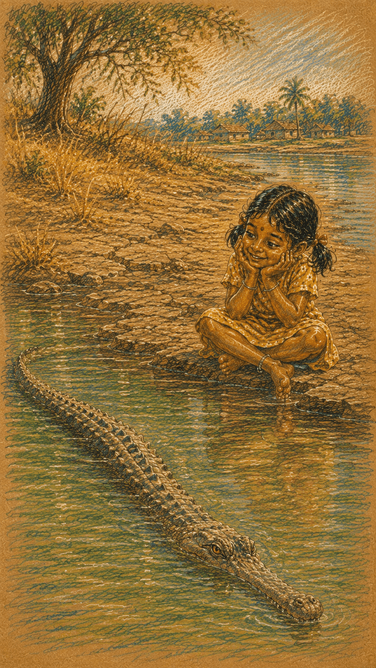
"My father is not going to stop drinking," she told him. "He says he will. But he says it up the hill, so you can’t hear."
"My mother says you are the best thing that ever happened to this village. She says her marriage has become very restful."
This went on all through the hot season, and all through the hot season Bhola grew thinner, and then thinner, and then flatter, until he did not look like a crocodile at all. He looked like a serious log with opinions.
Truth is very good for the soul, but there is nothing in it for a crocodile. Once Bhola had tasted the sweetness of a liar, ordinary ducks, fish, and crabs no longer satisfied his hunger. But nobody lied at Sonapani anymore, because they had all gone up the hill to do it.
Then, on a white afternoon at the end of the season, Rukku looked at him lying in the mud with his chin on a stone, and her heart turned over. So she leaned right out over the water until her nose was almost touching his, and she said, in her clearest voice:
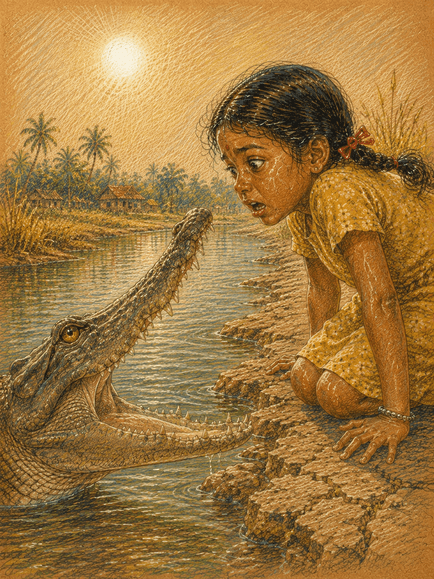
"Bhola. You are the handsomest creature in all of Barkuli."
It was a lie. It was the biggest lie ever told at that pond, because Bhola had a face like a dropped suitcase.
His mouth opened. Rukku could see every tooth he had. She counted eleven of them and then stopped counting, and she did not move at all.
Then his mouth closed again. Gently. On nothing.
Because Bhola had been thinking, down there in the mud. He thought about Ghisu, who had lied about his milk so that nobody would catch him. He thought about Uncle Sunil, who lied about paying debt, so that he would avoid paying at all.
Then he thought about Rukku, who had lied about his face so that he would feel better. They were not the same thing at all.
And the moment he worked that out, he understood what he had done to himself. Every grown man in Barkuli was two hundred feet up the hill. The only person who ever came down to his pond was Rukku. And he had just decided, forever, that he could never eat Rukku.
There was nothing left in Barkuli for a crocodile to eat.
So Bhola went away to the city, where lying is grown as a crop and harvested twice a year. After one season he was the size of a boat. After two he was the size of a small bank.
Barkuli came back down the hill that same week. Sattu tested it first. He stood ankle-deep in the shallows and promised a man Thursday, and the water did not move, and Sattu counted to a hundred, and the water still did not move. By evening the whole village knew. By the next morning it was as though the eleven years had never happened.
The vaidya came down. The marriage parties came down and stopped shouting and went back to telling each other beautiful, ridiculous things. Everybody was much happier, and slightly ashamed of being happier.
Only Rukku still goes down to the water and sits with her feet in it, in the one place in Barkuli where nothing dangerous lives anymore.