
THE TRAIL OF SILVER
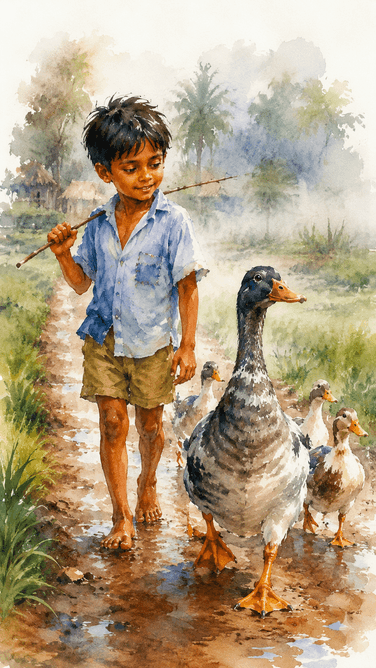
In a small village beside a mango grove, there lived a boy named Somu. He was seven years old. He wore khaki shorts, a patched shirt, and no slippers at all. He lived with his mother.
His father had passed away while he was one monsoon old. Every morning he took his ducks down the mud path to the village pond, and every evening he brought them back again. They were poor, and the ducks were nearly all they had.
The flock was led by a big grey drake called Raja. Raja had a very loud quack and a very sharp eye. He could see a shining thing from thirty paces, and he pecked at every single one of them.
At night, Somu’s mother would sit by the cooking fire and tell him stories, each with a moral. Out of all these, one thing usually stuck in Somu’s little brain: "Whatever you have not earned with your own two hands, and whatever nobody has given you — that thing belongs to somebody else."
Somu did not always understand her. But he remembered the words, because she said them so often.
One cold morning, Somu took his ducks down the path. A white mist hung over the fields. The dew on the grass was so cold that it stung his bare feet.
Halfway to the pond, Raja stopped. He stretched out his long neck. Then he began to peck hard at the wet earth. Somu knelt down to see what had upset the drake. Something round and bright was pressed into the mud. He pulled it out and rubbed it clean on his shirt.
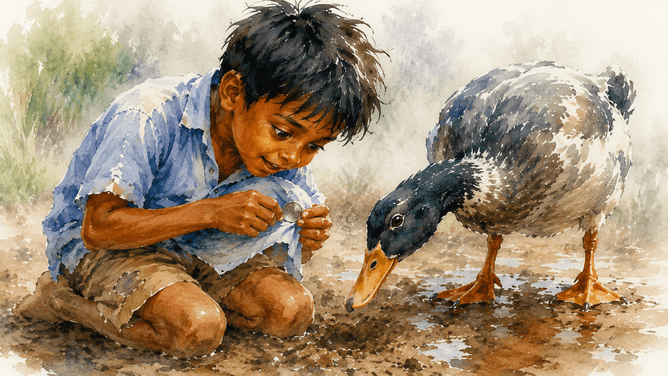
It was a silver rupee.
Somu’s heart jumped. A whole rupee was a great sum for a small boy. He thought at once of Kishan the sweet-seller, who sat every morning beside his black iron pan in the market, dropping curls of batter into hot oil. One rupee would buy a large paper cone of jalebis so hot that a boy would have to blow on them.
Then he closed his fist around the coin, and his mother’s words came back to him. He had not earned this rupee. Nobody had given it to him. So, it belonged to somebody else. Somu sighed. He pushed the coin deep into his pocket and walked on.
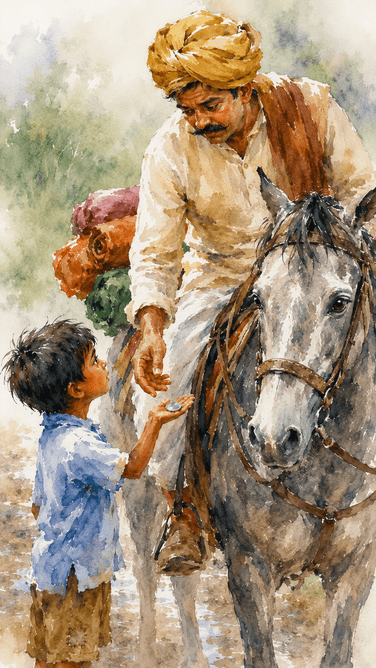
Before the sun had burned off the mist, a cloth-merchant came riding down the path on a grey pony. Bundles of cloth were tied behind his saddle. He rode very slowly, looking to the left and to the right, and his face was long with worry.
Somu folded his hands. "Namaste, uncle. Have you lost something on this road?"
The merchant reined in his pony. "I have, little one. A silver rupee slipped out of my waist-cloth. I am sure it is lost in the mud forever."
Somu held out his small, dirty hand. "I found it, uncle. I kept it safe for you." The merchant looked at the coin. Then he looked at the boy. "You are a truthful child," he said.
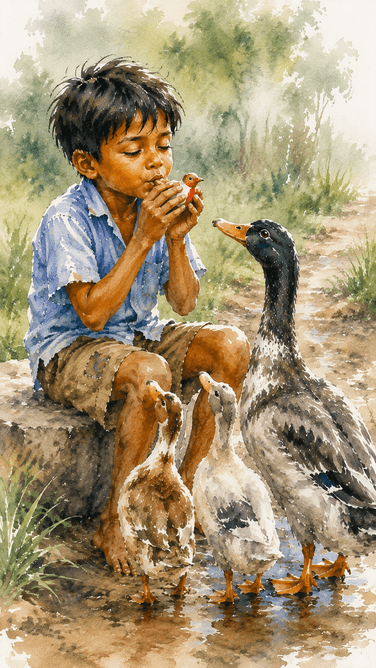
He opened one of his bundles and took out a little clay bird whistle, painted red and white. "Take this. It is a small thanks for an honest heart."
Somu took the whistle. The merchant rode away toward the village, humming a tune as he went. Somu sat down on a stone and blew into the clay bird whistle. It made a sweet, watery trill. The ducks lifted their heads to listen.
His peace did not last long.
Raja began to quack again. He went waddling off toward a clump of dry grass further down the path, and the whole flock hurried after him. Somu followed. And there, sitting neatly in the middle of a broken leaf, was a second silver rupee.
"How strange," said Somu. "Did the merchant lose two?"
He had barely picked it up when Kishan the sweet-seller came puffing up the road. Kishan was dusted all over with white flour, and his hands still smelled of hot oil. He was staring hard at the ground.
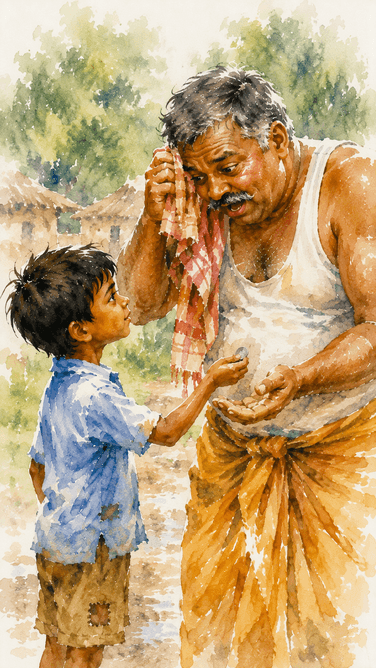
"Namaste, Kishan uncle," called Somu. "Are you looking for a rupee too?"
"I am, boy!" Kishan wiped his forehead with his shoulder-cloth. "This very morning I found a silver rupee lying on the road at the edge of the village. I tied it into the corner of my cloth to buy a new iron pan. But the knot came loose! I have walked backwards for a whole mile looking for that coin."
Somu handed him the second rupee. Kishan blessed him ten times over and hurried back to his shop.
Somu stood on the path and scratched his head. The merchant had lost a rupee. Kishan had found a rupee and then lost it. It was all very puzzling. Behind him, Raja quacked once more.
Somu turned around. The drake was pecking at the ground. Then a second duck pecked at something. Then a third. Somu walked forward and gasped.
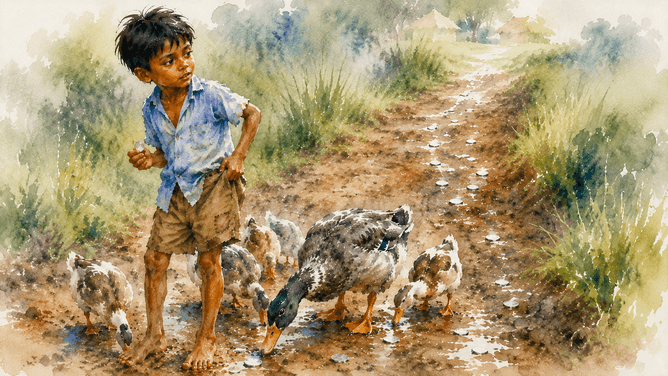
There, shining in the mist, was a silver rupee. Ten paces further on lay another. And another after that, and another beyond it — a long trail of silver running up the slope of the road and out of sight.
Somu walked up the road and picked up every coin. The ducks came quacking behind him. His pockets grew heavier and heavier, until they clinked at every step.
Now his heart began to thump. One rupee had been easy to give back. But this was more silver than his mother earned in a whole year. Nobody had seen him pick it up. Nobody knew he had it at all.
Somu stopped and stood very still on the cold road. Then he thought of his mother beside the cooking fire, and he kept walking. The trail led him around a bend, past a peepal tree. There the great mystery was solved.
A bullock cart stood tilted into the ditch with one wheel off the track. The two bullocks chewed patiently. Beside them stood Deenanath, the village patwari, looking thoroughly miserable. In the back of the cart lay a cloth bag of the village land-revenue. It had caught on a sharp nail in the boards, and the nail had torn a small hole in the bottom. All morning, as the cart bumped along the road, the bag had been quietly dripping the village’s silver, one coin at a time.
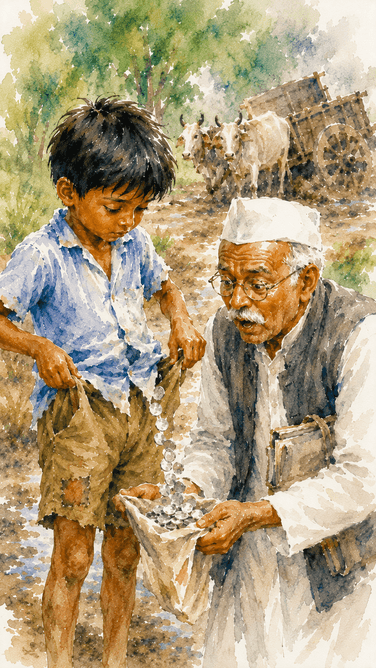
Somu walked up to the unhappy man. He turned out both his pockets and poured the coins into the patwari’s cloth.
Deenanath stared. Then he began to laugh with relief. Somu told him the entire story of that morning.
"So that is where it all went," he said. "And now I understand something else besides."
"What, uncle?" asked Somu.
"That cloth-merchant never lost his own money at all. He must have picked up one of my coins on his way out of the village, thought it was his, and dropped it again in the mud. And your Kishan did exactly the same thing — he told you so himself." The patwari shook his head. "Two grown men chasing silver that was never theirs. And one small boy who returned every coin he touched."
Deenanath knotted up the torn bag. He propped the cart wheel with a stout branch and heaved it back onto the track. Then he walked Somu and the ducks all the way home.
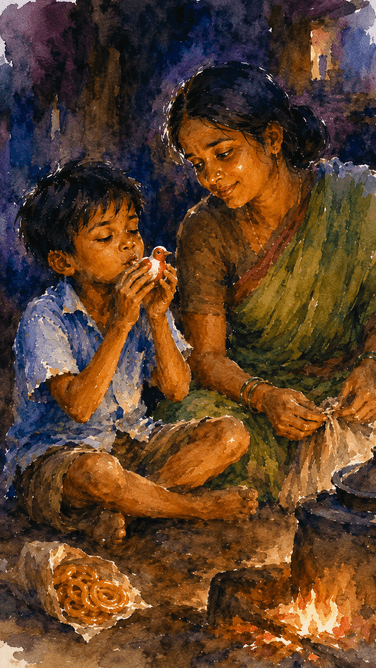
He did not go to his office first. He stopped at Kishan’s shop and bought the largest cone of hot jalebis in the market, and he put it into Somu’s hands.
"You have saved the whole village’s revenue," he said. "And you have shown us that an honest heart is the sharpest eye on the road."
That evening Somu sat beside the cooking fire. His fingers were sticky with syrup. He blew a thin, sweet tune on his little clay bird while his mother smiled over her work.
Out in the yard, Raja slept soundly with his head tucked under his wing — for he had found all the silver in the village, and he had not kept a single coin of it either.
Moral of the story
A coin you did not earn is heavy in the pocket, however light it feels in the hand.