
AMBHIMAYU AND THE CHAKRAVYUH
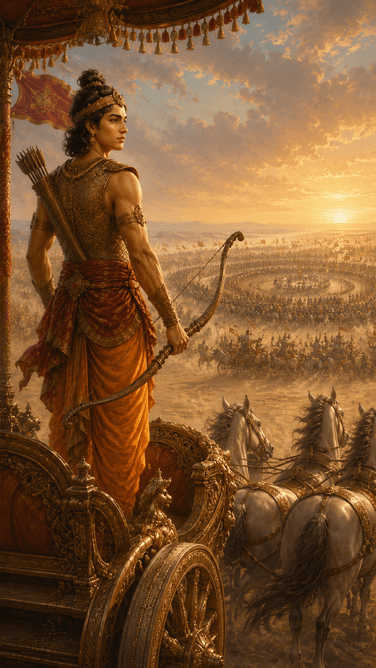
On the battle-field of Kurukshetra, the elders of war knew many Vyuh formations. They knew the soaring eagle and the crescent moon. But there was one formation they spoke of only in hushed, heavy voices: the Chakravyuha.
It was a labyrinth of spinning iron, a vast, grinding wheel made of chariots, spears, and marching feet. It was designed to do one thing: swallow a warrior whole and grind them to dust.
On the thirteenth day of the great war, the Pandava camp was quiet with despair. The architect of the Chakravyuha, the great teacher Drona, had deployed it. The Pandava army was locked outside, their greatest warrior, Arjuna, lured far away.
Without Arjuna, the great spinning wheel could not be broken. Nobody stepped forward to face it. Nobody except Abhimanyu. Abhimanyu was sixteen monsoons old, and he knew the way in.
Years ago, before he was even born, he had listened from the dark safety of his mother Subhadra’s womb. His father, Arjuna, had been whispering the secrets of the Chakravyuha. The unborn child had memorized every turn, every rotation, and every weak point of the spinning maze. But mid-way through the telling, his mother had fallen asleep. Abhimanyu knew exactly how to pierce the rings of the wheel. He just did not know how to get back out.
"I will go," he told his uncles.
They protested. He was only a boy, barely old enough to tie his own armor without help. But the army was breaking, and the wheel was turning.
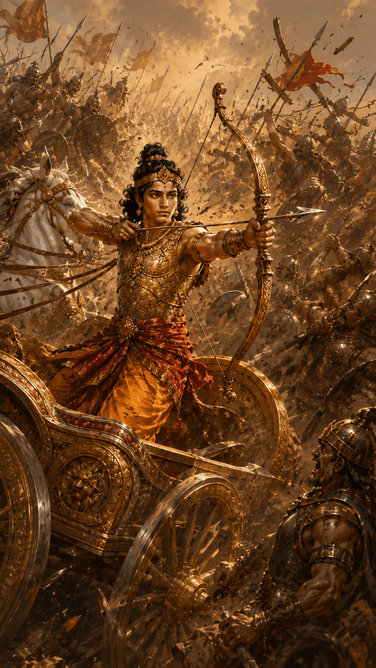
So he rode out.
The Chakravyuha spun before him, a wall of dust and glaring eyes, shifting, grinding, waiting. Abhimanyu did not hesitate. He ordered his charioteer forward, straight into the churning maw. He struck the first ring. Crack. The impossible maze shattered open. He wove through the heavy infantry, spinning and striking, and before the Kaurava army could comprehend what was happening, he was through the first barrier.
Then, the heavy, rotating walls of the wheel closed behind him. His uncles, who had sworn to follow, were blocked by the sheer might of a single king guarding the entrance.
Abhimanyu was entirely alone. He did not panic. Surrounded by the oldest and most hardened warriors of the age, he simply tightened his grip on his bow. He tore through the second ring, then the third, then the fourth.
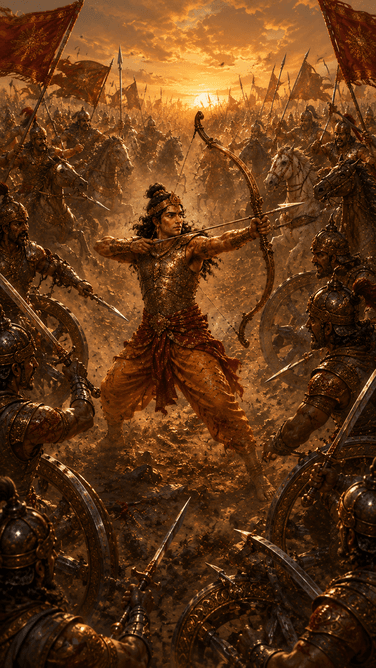
The great generals of the Kauravas watched in stunned disbelief. The maze was supposed to crush him. Instead, he was dismantling its spokes from the inside out. He fought Drona, the master of all weapons. He fought Karna, the sun’s own son. He fought Duryodhana, the furious king. For half a day, the entire might of an empire was held at bay by a single sixteen-year-old boy. The Kaurava generals realized then that they could not beat him by the rules of war. So, abandoning every sacred vow of combat, they surrounded him. Six of the greatest warriors on earth against one tired boy. They shot his horses. They cut his bow. They shattered his chariot.
He stood in the dust, weaponless, bleeding, his armor heavy and broken. The battlefield went completely still. The great warriors paused, waiting for him to surrender.
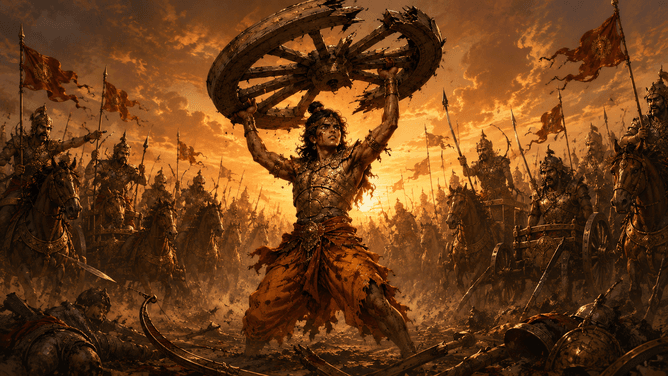
Abhimanyu did not ask for mercy. He bent down, gripped the heavy, shattered wheel of his own ruined chariot, and lifted it above his head. He spun it, the wood groaning and the dust flying. He became a Chakravyuha of his own making, meeting the great iron wheel of the Kauravas with a broken wooden one of his own. He fought until the wood splintered. He fought until he had nothing left to give, finally falling as the sun went down.
The Kaurava army did not cheer. Drona lowered his head. Karna looked away. They had won, but standing over a boy who had fought with such absolute resolve, the victory felt entirely hollow. There is not much more to tell of that day. The war would go on, and the earth would drink much more blood. But if you ever read the old epics, you will find that nobody remembers the men who survived the Chakravyuha on that thirteenth day. They only remember the boy who didn’t. Because everyone who hears the story of Kurukshetra learns what Abhimanyu taught the world in the dust of the labyrinth: that true victory is not always about walking out of the maze alive. Sometimes, it is about standing so unyielding in the dark that your enemies are forced to remember your courage.