
THE FIREFLY NIGHT
The first rain of June came to Umbarwadi at dusk. It fell hard, then stopped, like a visitor who could not stay. By the time the stars came out, the lane had drunk every drop, and the whole village smelled of wet earth — that deep sweet smell that made even the buffaloes lift their noses.
In the courtyard of the last house before the fields, the cooking fire had burned down to a heap of red embers. Aaji sat beside it on her low wooden stool, cleaning the big brass pot with ash. Her thin white plait hung over her shoulder like a lamp-wick. Malati — Malu, to the whole village — lay on the cot with her head hanging off the edge, looking at the world upside down and wiggling her loose front tooth with her tongue.
Beyond the wall, the frogs had started. All summer they had been silent. Now, after one rain, a hundred of them were shouting from the ditch, as if they had been practising underground. Past the corner streetlight, the fields lay in the deep kind of dark. The kind you could put your arm into, like a bin of grain.
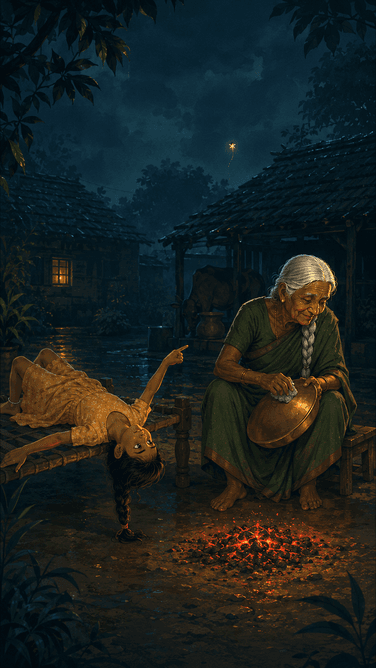
Then Malu saw the spark.
It rose from behind the cowshed, floated, went out. Lit again, a little higher. Went out.
"Aaji!" She was off the cot in one jump. "A spark is flying! From the fire — look — it’s flying!" Aaji looked. Then she went very still, the way she went still at the last note of the temple bell.
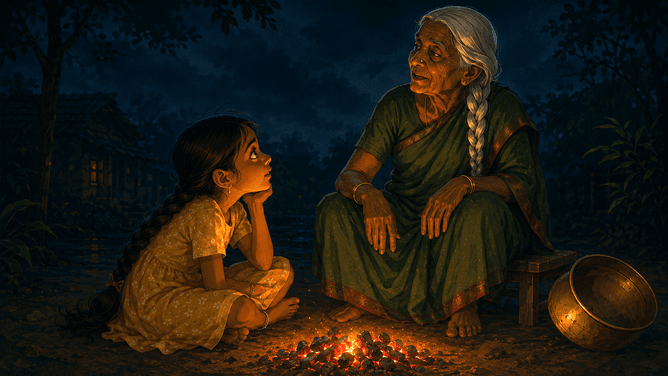
"That is no spark, bala," she said. "That is a kajva. A firefly." She patted the ground beside her. "Sit. I will tell you about the night I saw ten thousand."
Malu sat down so fast she nearly missed the ground.
"I was nine," Aaji said. "I had a loose tooth, just like you. It was this same house, this same week of June. The mangoes were finishing. The first rain had fallen. The seed-beds were full of new green rice.
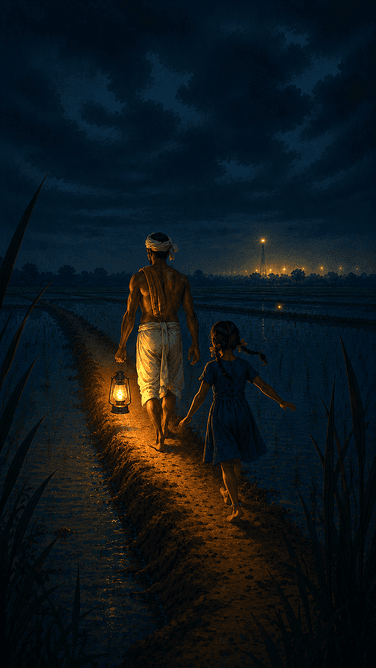
"That night my Anna put his hoe on his shoulder and went out to open the water channel, to let the water into the seedlings. I asked and asked, so he let me come.
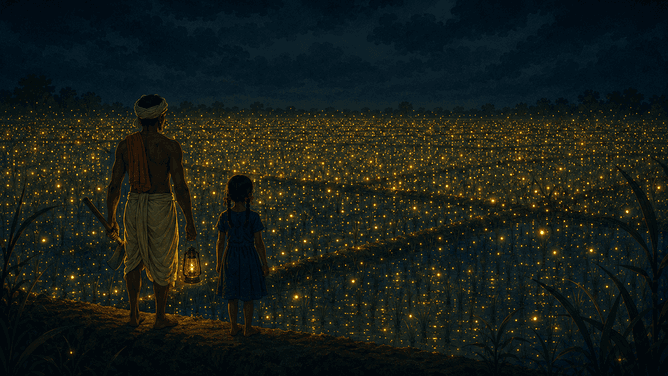
"We walked the path on the mud wall, in the dark. There were no streetlights then. No bulbs at all — only Anna’s lantern swinging, and the frogs going like a wedding band. And when we climbed the last wall and looked down into the low field—"
She stopped. Malu leaned forward until her plait swung near the embers.
"The field was full of light. Not one light. Not a hundred. The grass was lit. The air above the grass was lit. And the water in the seed-beds was lit twice, because every firefly had a reflection under it."
"Like stars fallen into the rice," Malu whispered.
"Just so. I forgot to breathe. Anna forgot his channel. We only stood there.
"Then one came and sat on his sleeve. ‘A fly!’ I said. ‘A fly carrying a lamp!’
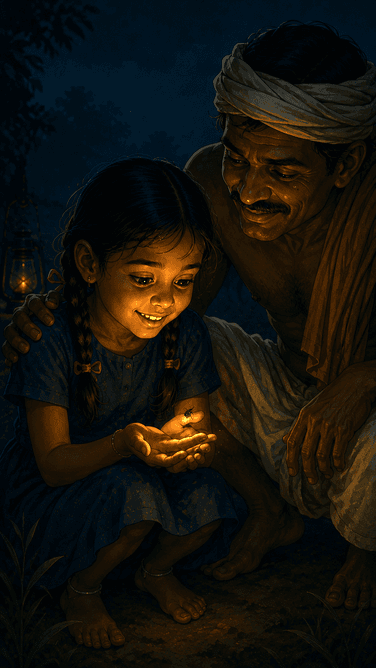
"Anna laughed at me. ‘Fly? Look at its back, Saku. Two little doors, hard as your fingernail. When it wants to fly, it opens the doors, and the real wings are folded up underneath. A fly has no doors. This is a beetle. A small beetle that learned to make fire that does not burn.’
"’It will burn your hand, Anna!’
"’Will it?’ He cupped it the way you hold a chick, and tipped it into my hands. It walked up my finger and lit itself. And listen, Malu — there was no heat. None at all. The glass of the lantern would bite you if you touched it. This little lamp was cool as a river pebble." "But how?" said Malu.
"That is what I asked. Anna sent me to my brother Vishnu, who went to school and was very proud of it. He sat us down at dinner and explained it like a schoolmaster.
"Inside the firefly’s belly, near the tail, there is a small lantern-room. In it the firefly keeps a juice. The schoolmaster’s name for that juice was luciferin, and we all said it three times because it sounded like a name for a girl.
The firefly opens a tiny door and lets in air — and in the air is oxygen, the same thing you and I breathe. The juice and the air meet. And the firefly’s own body has a helper that stirs the two together, the way one spoonful of old curd turns a whole pot of new milk. When they mix, they make light.
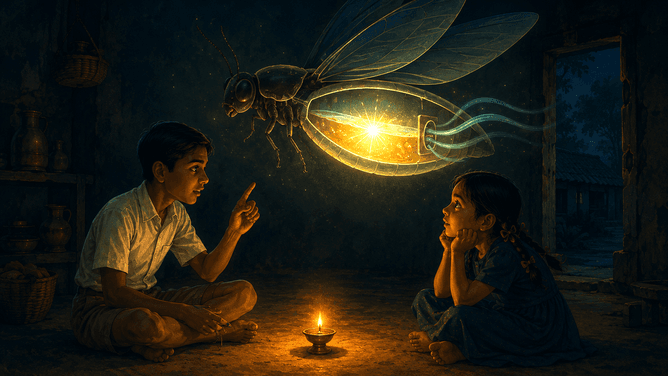
"Now here is the true wonder, bala. Think of our lantern. Most of its oil goes into heat. Only a little becomes light — that is why the glass burns you. The kajva wastes almost nothing. Nearly all of it becomes light, and hardly any becomes heat. The smallest lamp in the world. And the coolest. Even a fire cannot do that."
"And it can turn it off?"
"On and off, as it pleases. Which is the whole point, Vishnu said, because the light is how they talk." "Talk?"
"How else, in that much dark? Light is their language. And each kind of firefly keeps its own beat. The ones by the river went blink — long dark — blink, slow as a bullock blinking at noon. The ones in the mango branches went blink-blink-blink, quick as a sparrow’s heart. So a firefly in the air asks in its own rhythm, and if a firefly of the same kind is sitting in the wet grass, she answers in the same rhythm. And that is how they find each other. Question, answer. Question, answer. All across the field, the whole night. Ten thousand small lamps, and not one of them lost."
The embers ticked. A frog stopped, then went on. "Then where did they go?" Malu asked.
Aaji was quiet for three frog-calls.
"They are born in the damp dark," she said. "Their young ones live in the wet ground — under fallen leaves, along the river bank, in the soft mud at the edge of the paddy. They do not even have wings yet, and still they glow, down there in the leaves. The marsh below the mango grove was full of them. It was their nursery.
"That marsh was filled and flattened for the brick sheds, when your father was a boy. Then the sprays came, to kill the insects that eat the crop. But a spray cannot stop to ask which insect glows.
"And then—" she lifted her chin toward the corner streetlight, and past it, toward the pale glow of the highway and the tall lamp on the temple mast, "—then all our lights came. Their words are made of light, Malu. Who can see a diya at noon? Now they flash, and flash, and nobody sees them. Nobody answers."
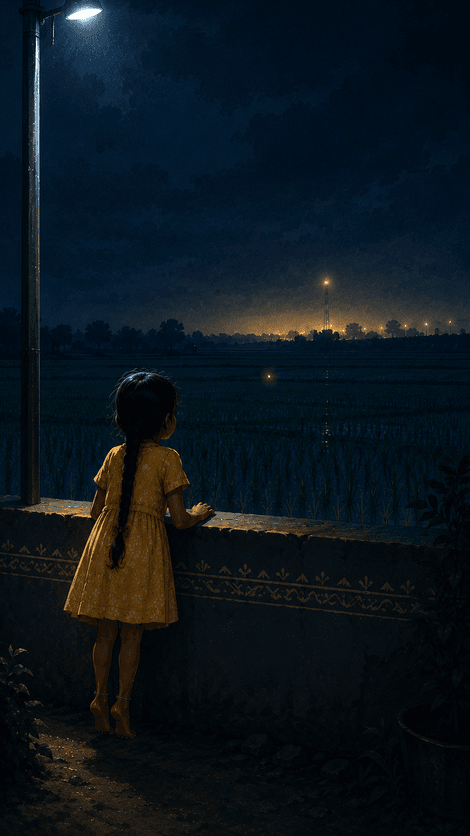
Out past the cowshed, the one kajva rose again. It crossed the courtyard wall slowly, blinking its slow question, and drifted beyond the streetlight, out over the wide dark field where the seed-beds stood full of new green rice, just as they had when Aaji was nine.
It blinked. Waited. Blinked.
The field did not blink back.
Malu stood on her toes at the wall, her tongue pressed against her loose tooth, watching the small light ask and ask, farther away and fainter, over all that dark.
"Aaji," she whispered. "Who is he asking?"
Behind her, the embers settled. The frogs sang on. Aaji drew Malu’s plait once through her hand, the way you straighten a lamp-wick, and said nothing at all.