
THE MERCAHNT’S CHEST
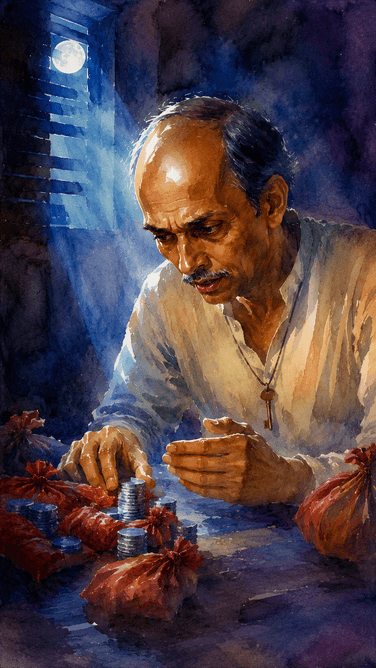
Every full moon, when the sky was bright and the town was asleep, Seth Maniram locked his door and counted his silver coins, because oil cost money and moonlight was free.
That night he had three hundred coins, kept in thirty bundles, ten coins to a bundle, each bundle tied in a bit of red cloth.
When the last knot was tied, he kissed the little key that hung on a black thread round his neck, and he went to bed as a happy man.
Maniram’s shop stood in the town of Rupnagar, where the bazaar road met the steps of the river.
From his seat he could smell the jalebis frying in ghee across the lane, hear the temple bell at noon, and watch the grain boats come and go. He liked it very much, as all this cost him nothing.
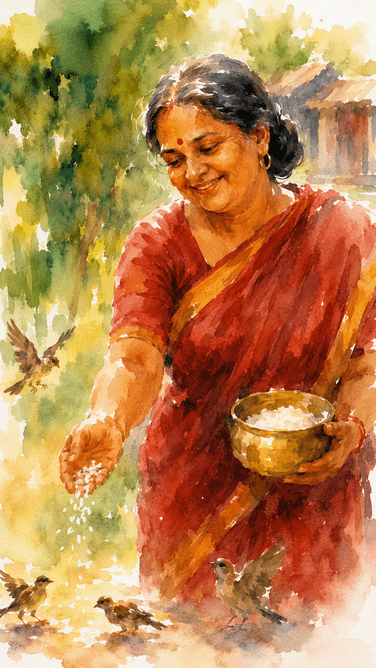
However, not everyone in his household shared his miserly ways. His wife, Ganga, was much more generous.
She fed the sparrows every morning, throwing them a fistful of rice before anyone in the house had eaten.
Maniram did not like this. "A fistful a day is a whole sack in a year," he said. Ganga only smiled. "The birds sing for it," she said. "That is a fair price." Maniram had no answer for that, so he said nothing.
There was a servant boy in the house named Gopi. He was a cheerful boy, and he loved the two bullocks, Moti and Heera, more than anything else; he talked to them while he fed them, as if they might talk back
Once, on a bazaar day, a hen got loose from the poultry-man’s basket, and half the town ran after it, laughing, in and out between the sacks of grain. Gopi ran too, waving his arms. But Maniram did not even look up. A man who looks up, he thought, is a man whose purse gets cut. And Maniram was extremely cautious of his purse.
That winter a thief broke into the oil-seller’s house and took two brass pots and a gold nose-ring. After that, Maniram could not sleep, terrified that his own silver might be stolen next. He realized he needed a clever way to hide his wealth.
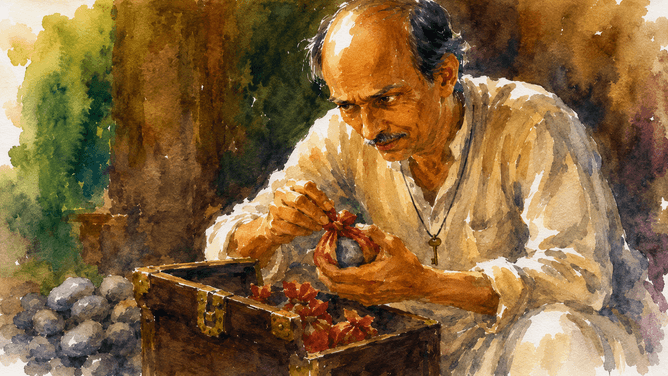
As he paced his room, he remembered that his father had left him two chests of dark wood with brass corners. They were made so alike that no one could tell them apart — not by their look, not by their weight, not even by a knock on the lid. Looking at them one morning, Maniram thought of a plan. He filled the second chest with smooth stones from the river, and he wrapped each stone in red cloth, just like a bundle of coins. Then he set both chests on his big grain scale and added stones until the two sides hung level.
"Come and steal it," he said to the empty shop. "Run all night with a box full of river stones." Only Maniram knew which chest was the true one, and he knew it by where it sat. The true chest he buried deep in the heap of paddy in his storeroom. The false one he pushed under his own bed, where a thief would look first.
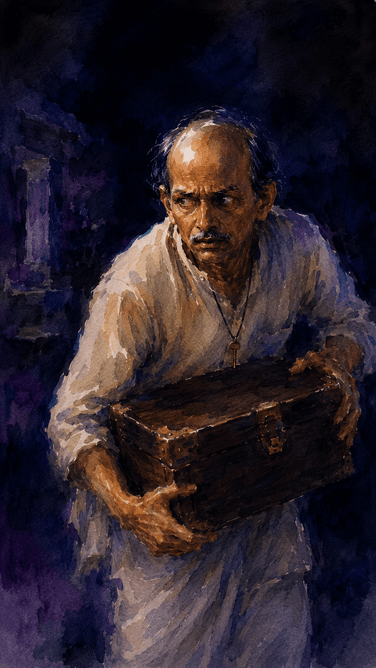
But Maniram trusted no one, and soon he did not trust his hiding places either.
Every new moon he moved the chests about — the true one up to the cowshed rafter, the false one down to the paddy heap, and the next month the other way around.
He did it at midnight, in the dark.
A lamp would have made it easy, but a lamp meant oil, and oil meant money. So, he moved them by feel and by memory, and he was sure his memory never slipped. This pattern continued for a while in Maniram’s life.
One day a pearl merchant named Motichand came up the river from the south. He was in a great hurry, for his boat had to leave in two days to catch the tide. He had two hundred river pearls, and he would sell them for three hundred silver coins. Everyone at the temple said the pearls were worth a thousand coins in the big cities. Everyone said it twice.
"Bring me the silver at the temple at noon tomorrow," said Motichand. "The pearls go to the first man who pays."
That night Maniram lay awake and did his sums. Three hundred coins would buy the pearls. The pearls would sell for a thousand. A thousand, spent well, would grow to three thousand. He wanted those pearls the way a dry field wants rain.
The night before the sale was a new-moon night, black as the inside of a well. Near midnight Maniram crept to the storeroom to be near his silver. There in the dark a small worry bit him: had he moved the chests this month, or had he only meant to? He could not remember. So, to be safe, he moved them once more — the true one here, the false one there — feeling his way, breathing softly. Somewhere a dog barked, and he froze with his hands on the wood until it stopped.
Panicking, he rushed to finish, sliding one chest under his bed and burying the other deep in the paddy heap. Finally, Maniram slept with one hand on the brass corner of the chest beneath his bed, certain he held the right one.
By noon the temple courtyard was full of people. Gopi and a porter carried the chest from under the bed, and Maniram walked behind, arguing with the porter about his pay. Seth Hazarilal was there too, a fat trader who laughed at his own jokes before he told them. Half the bazaar had come to watch, and the air smelled of marigold flowers and warm stone. Motichand spread the pearls on a white cloth, where they lay round and shining. The old priest sneezed right in the middle of his blessing, and everyone laughed and called out, "Live a hundred years!"
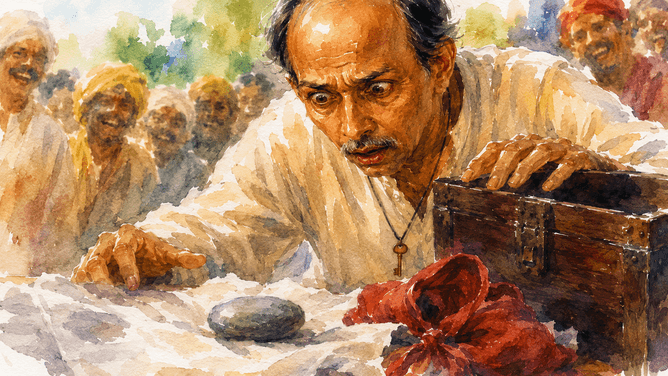
"You may count my money," said Maniram, loud and proud. "Three hundred coins, not one less." "Open the chest first," said Motichand. "We will count after."
Maniram lifted the key from the thread round his neck, turned it in the lock, and raised the lid. Inside sat thirty red bundles in neat rows. He picked up the first one and untied the knot. A smooth grey stone rolled out onto the white cloth. It still smelled of the river, and a little green moss clung to its side.
For a moment no one said a word. Maniram untied the second bundle. A stone. The third. A stone. Then the whole courtyard began to laugh. A small boy on the temple steps shouted,
"The Seth has come to sell us stones!" Even the priest hid his smile behind his shawl. "Bring me silver, my friend, not the riverbed," said Motichand,
and he folded the pearls away. He was not unkind about it. Somehow that made it worse.
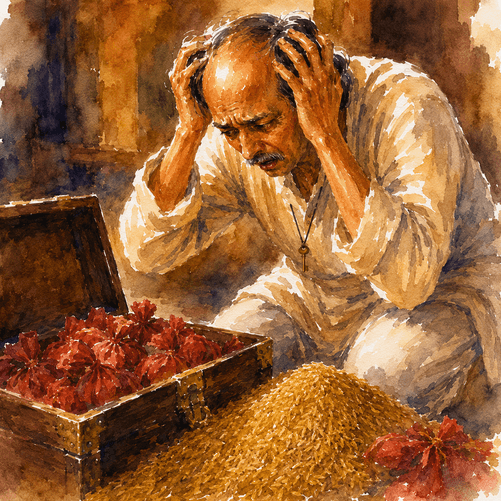
Maniram ran home, dug into the paddy heap, and there sat the true chest, safe and full, every coin in its place. Nothing had been stolen. No thief had ever come. In the dark he had moved the chests one time too many and carried the wrong one to the temple. A single lamp, lit just once, would have shown him his mistake in a breath.
But Maniram had never in his life burned good oil to save himself trouble.
By the time he got back to the river, the boat was only a small brown dot far downstream, and Seth Hazarilal stood on the steps holding the pearls, laughing and laughing. The missed fortune was a heavy blow, but the town’s teasing made it even harder to forget.
For a whole month after, children came to Maniram’s shop, held up little stones, and asked him sweetly, "Seth-ji, how much for this one?"
Moral of the Story
Don’t let your desire to save a little bit of money ruin a big opportunity.