
THE POTTER’S QUESTION
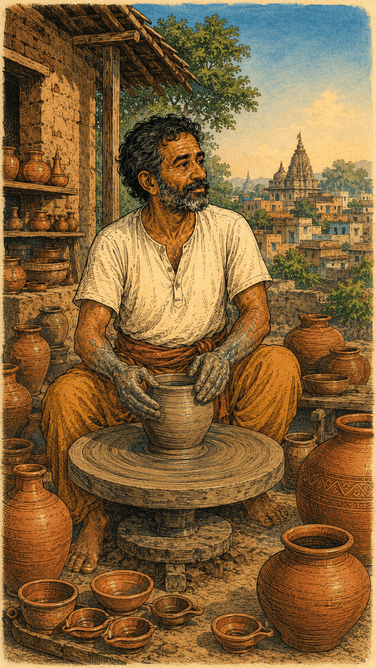
In the kingdom of Vijayapura there lived a potter named Govinda. He was neither rich nor poor, neither famous nor forgotten. Every morning he would sit at his wheel and shape vessels out of clay — pots for water, lamps for oil, jars for grain. His hands knew the clay as a mother knows her child, and everything he made was sturdy and true.
Now, King Vikramasimha of Vijayapura was a proud ruler. He believed that wisdom belonged only to those who had studied the scriptures, debated in the great halls, and earned titles after their names. He kept twelve scholars in his court and paid them handsomely.
These scholars spent their days arguing with one another about the nature of truth, the origin of the universe, and the meaning of virtue. The king enjoyed these debates immensely, for they made him feel that his court was the wisest in all the land.
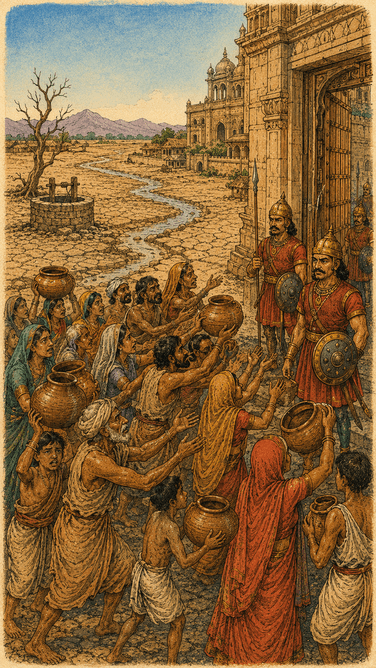
One summer, a terrible drought fell upon the kingdom. The rivers shrank to muddy ribbons. The wells went dry. The fields turned to dust. People came to the palace gates begging for water, but even the royal reservoirs were running low.
The king summoned his twelve scholars and said, “You are the wisest men in my kingdom. Tell me how to bring water to my people.”
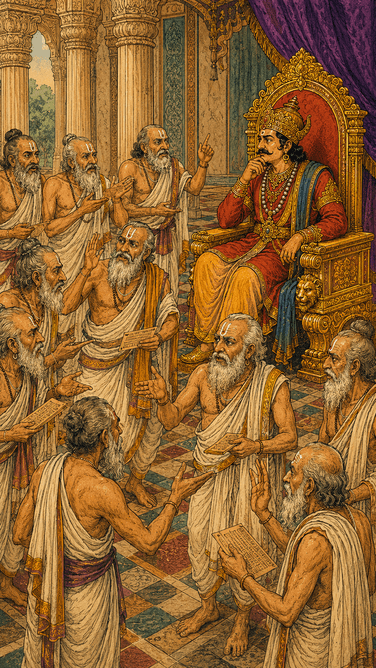
The first scholar stood up and said, “Sire, according to the ancient texts, rain is produced when the fire-god sends his heat upward and the wind-god carries moisture from the oceans. We must perform a great yagna to please both gods.”
The second scholar objected. “That is the old interpretation. The newer commentaries say that rain depends on the alignment of certain stars. We must wait for the constellation of Pushya to appear in the eastern sky.” The third scholar said that neither was correct and quoted a verse from a text that the other two had never heard of. The fourth scholar questioned whether the verse was authentic. The fifth scholar questioned whether the fourth scholar was qualified to question authenticity. And so it went.
Three days passed. The scholars argued from dawn to dusk. They quoted texts, cited authorities, challenged one another’s interpretations, and produced no water whatsoever.
Meanwhile, the people grew more desperate.
On the fourth morning, a humble potter appeared at the palace gate carrying a large clay pot on his head. It was Govinda. The guards tried to turn him away, but he said, “I have come to answer the king’s question.” The guards laughed but let him through, thinking the king might enjoy the joke.
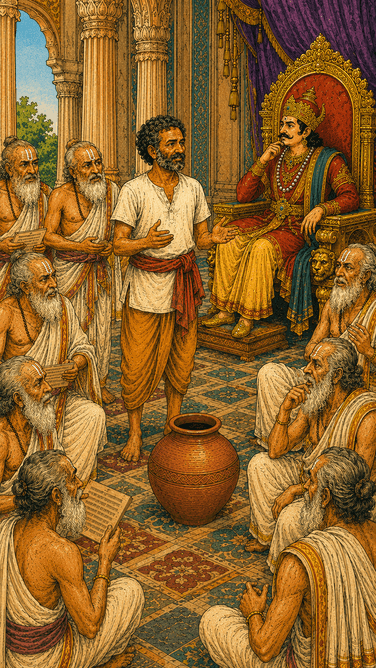
Govinda entered the great hall where the scholars were deep in their fourth day of debate. He set his pot down before the throne and bowed. “Who are you?” asked the king.
“I am Govinda, the potter from the eastern quarter, Your Majesty.”
“And what business does a potter have in a hall of learned men?”
“Sire, I heard that you asked how to bring water to your people. I have come with a question of my own. May I ask it?”
The king was amused. “Ask,” he said.
Govinda turned to the twelve scholars and said, “Learned sirs,
I make pots. When I want to make a pot, I do not first debate whether clay is earth or whether earth is clay. I do not ask whether the wheel turns because of my hand or because of the nature of circular motion. I simply sit down and make the pot.
My question is this: if my well at home still has water in it, and I know of eleven other potters whose wells also have water — for we dug them deep in the old way, following the slope of the land — then why are we sitting here talking about stars and fire-gods when sixty pots of water could be on their way to the marketplace within the hour?”
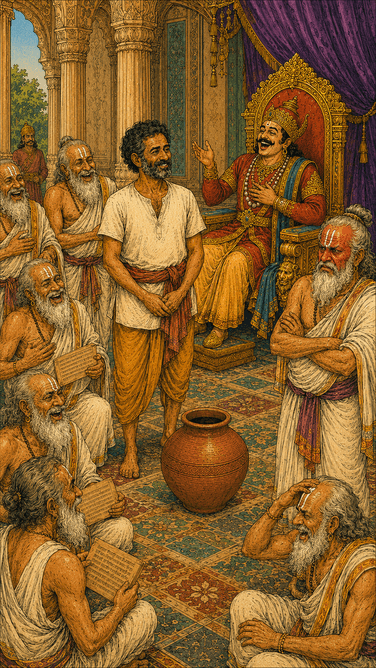
There was a long silence in the court.
One of the scholars said, “The king asked for a solution worthy of a kingdom, not the tricks of a tradesman.”
Govinda replied, “Sire, may I ask this learned gentleman one more question?”
The king nodded. “Sir,” said Govinda to the scholar, “when you are thirsty, do you drink water, or do you drink the idea of water?”
At this, the entire court burst into laughter — everyone except the scholar who had spoken and the eleven others who wished they hadn’t remained silent.
The king raised his hand and the laughter stopped. He looked at Govinda for a long time. Then he said, “Potter, you are right. Twelve wells with water in them are worth more than twelve scholars without a single pot to carry it in.”
That very hour the king sent his soldiers to Govinda’s quarter. The potters filled their vessels and the soldiers carried water to every corner of the city. By evening, every family had enough water to last three days. In those three days, Govinda and his fellow potters showed the king’s engineers where to dig new wells — for potters, who work with earth and water all their lives, know better than anyone where water hides beneath the ground
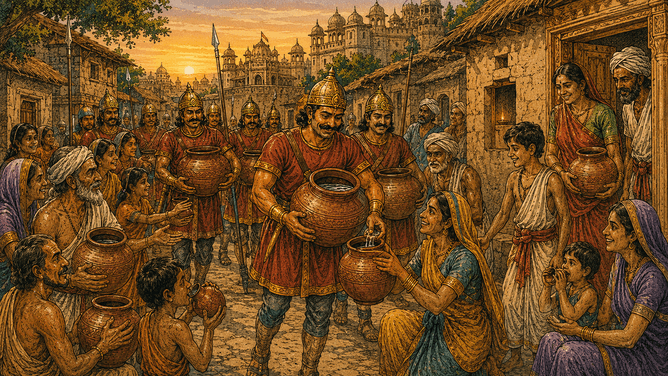
The drought did not end that week, but no one in Vijayapura went thirsty again. The king did not dismiss his twelve scholars. But he did something that annoyed them greatly — he appointed Govinda as the thirteenth member of the court, with the special title of “Keeper of Useful Questions.”
From that day on, whenever the scholars began a debate that wandered too far from the ground, the king would turn to the potter and say, “Govinda, do you have a question?”
And Govinda, who was a modest man, would simply ask, “Are we making pots, or are we talking about making pots?” That was usually enough.