
TIGER RIDER OF TRIHUT
In the old days, Trihut had two kings. One sat in Mithilapur on a throne of carved teak, and his name was Maharaj Hemant Sen. The other had enormous strength, wore stripes, and ruled the great sal forest that stood between the rice fields and the blue hills of the north. No villager spoke his name out loud. They called him the Old King, and when their bullock carts passed under the first trees, they folded their hands.
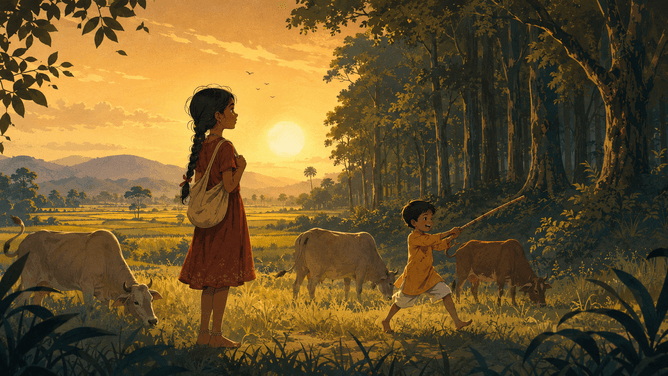
At the edge of that forest, in a village called Simariya, lived a cowherd’s daughter named Champa. She was eleven years old, thin as a reed and brown as river clay, and she knew the forest’s border the way other children knew their own courtyards — which trees dropped fruit and which dropped red ants, where the quail hid her eggs, how the wind smelled half a day before rain. And she was honest. So plainly, stubbornly honest that when the milk-women quarrelled over their measures, they sent for Champa to settle it, because everyone knew the girl could not bend the truth even to be polite. Her brother Bhola was six, and he followed her everywhere with a bamboo stick that was, depending on the day, a flute, a sword, or a horse.
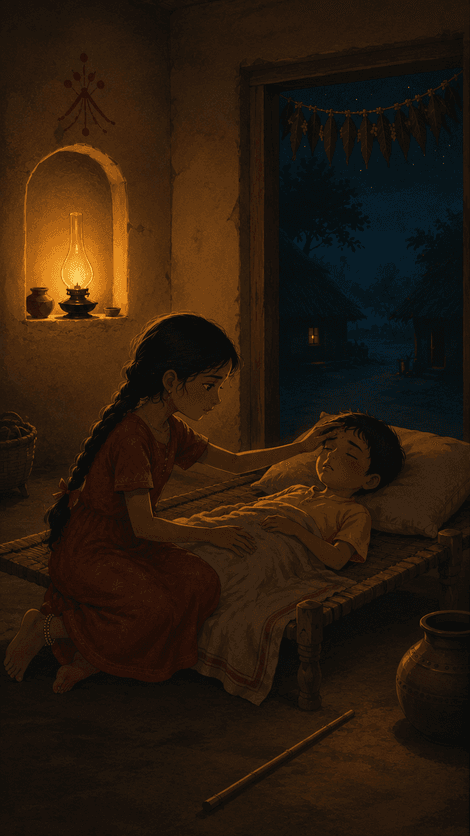
That year the floods came high and stayed late. When the water finally crawled back into the Bagmati river, it left something behind: the shivering fever.
It went from house to house like an unwelcome relative. First the children burned, then they shook, then they grew too tired to do either, and lay with their eyes half open, forgetting, little by little, how to be children.
Neem leaves hung on every door. The temple bell rang so often it stopped meaning anything. Bhola’s stick lay in the courtyard for three days before anyone had the heart to move it.
Vaidya Sadanand, the old physician, went from bed to bed, and his face grew longer at each one. And because the fever did not stop to ask whose roof it was entering, it walked into the palace too and laid its hand on the little prince of Trihut. That is how Maharaj Hemant Sen himself came barefoot to the ancient Shiva temple at the forest’s edge to pray — and how the whole kingdom heard the vaidya say, on the temple steps, the thing the old physicians had always known.
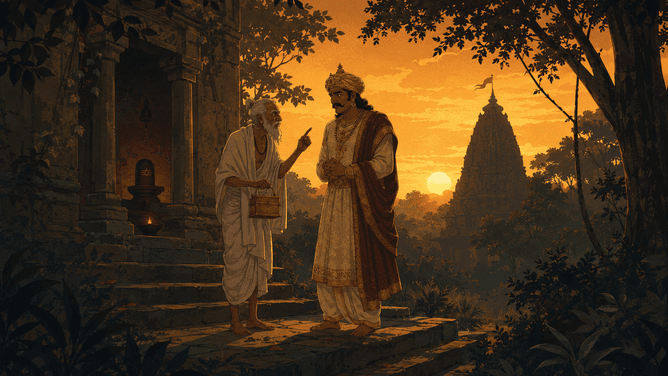
"There is a cure," said Sadanand. "One cure. On the bald hill they call Munda Pahar, the first hill of the north, grows the chandkali — the moon’s own bud. It opens only on full-moon nights, and its power lives from the moment it is plucked until the next sunrise. Crushed in milk, one petal on the tongue will drive this fever out like a dog drives a thief."
"Then why," thundered the king, "has no one ever fetched it?"
"Because, Maharaj," said the vaidya, "the hill lies three days’ walk from here, and every step of the way runs through the Old King’s forest. A flower that lives one night cannot cross a forest of three days. We have known this cure for a hundred years, ever since a hermit who lived on that hill first recorded it. We know it the way a poor man knows there is gold in the ground. Knowing and having are two different things." At that moment the king proclaimed a reward — gold, land, and a name honoured forever — for whoever put the chandkali in the vaidya’s hand before sunrise after the full moon. The drums carried the word to every village.
Three famous men answered.
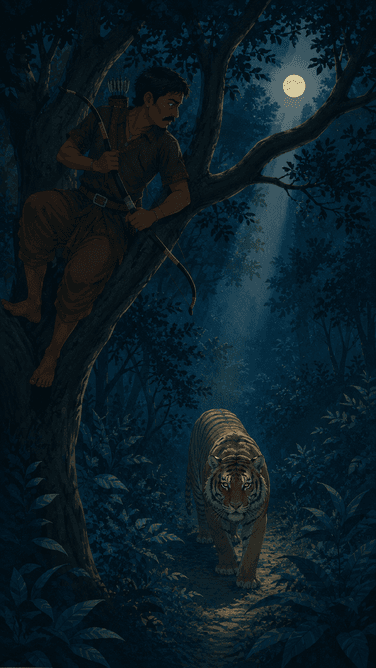
First went Veer Singh, the royal huntsman, with his bow of buffalo horn and a plan of beautiful simplicity: he would shoot the Old King, nail his hide to the temple door, and stroll to the hill as if going to a fair. He rode in at dawn with forty arrows.
He came out at midnight on foot, hatless, with thirty-nine, having shot the fortieth at a shadow and spent the afternoon up a jamun tree while something underneath him breathed like a slow bellows. "The forest is cursed," he announced, and collapsed in front of the temple.
Next went Bajrangi, the wrestler of Hajipur, carrying an iron-bound club and his own opinion of himself, which was heavier. He would not mark his path, because great men do not look back, and he would not ask the sun or the birds for directions, because great men do not ask. The forest listened politely to two days of his roaring and then let him out at exactly the spot where he had gone in. Bajrangi swore the trees had moved. Perhaps they had.
Last went Dhaniram, the merchant’s son, with fifty hired men, torches, drums, and a plan to burn a straight road to the hill. That night, out of season and out of nowhere, it rained as if the sky had been saving up for years. The torches died. Then, somewhere close in the wet dark, the Old King coughed — once — a sound like a boulder clearing its throat, and Dhaniram’s fifty brave men became fifty fast ones. Dhaniram himself was last heard offering the darkness one hundred rupees to let him pass. The darkness did not bargain.
The full moon was now three days away. Bhola had stopped asking for water. Seeing her brother in this condition, Champa said, "I am going."
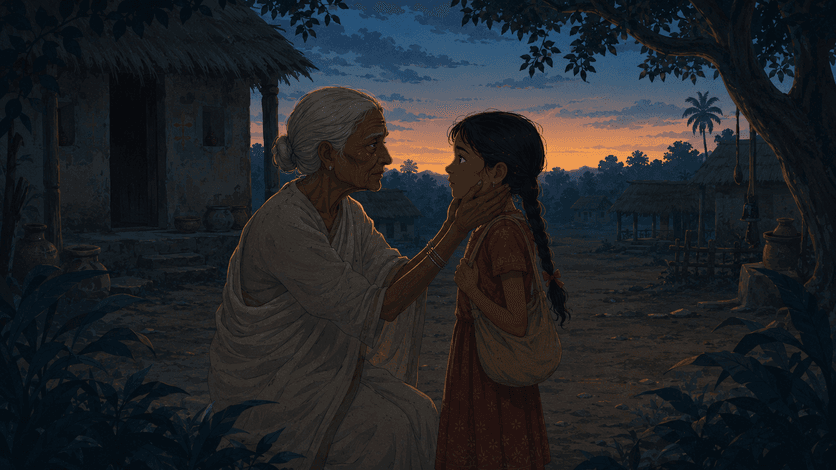
Her mother wept and forbade it. Her grandmother, who had told her stories of that forest all her life and therefore knew which ones were true, said nothing at all. She packed champa a cloth bundle — sattu, a lump of gur, a small brass lota — and then held Champa’s face in her two dry hands.
"Listen to me. Walk soft. Take nothing inside those trees that you are not given, and tell no lies under them, for the forest keeps accounts. And if you meet anyone on the path, remember — in a forest, nobody is like what they look like." Champa knelt by Bhola’s bed. His skin was hot as a griddle. She put her mouth close to his ear.
"Your only work," she whispered, "is to keep breathing till I come back. Do your work, and I will do mine." She left before the birds woke,
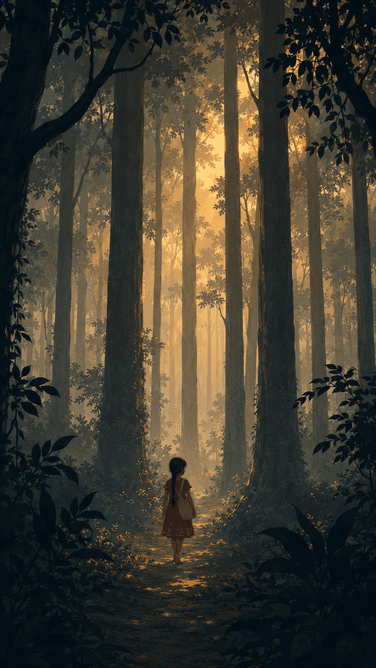
The forest at dawn was not what the champions had described. It was tall and quiet and endlessly green-grey, the sal trunks rising like the pillars of some roofless temple, the light coming down in coins. Champa walked soft, as she had been told, and touched nothing.
At midday she found an old woman under a huge semal tree, bent double over a bundle of firewood far too big for her. Champa carried it for her — and when they stopped to rest, she opened her sattu, and the old woman ate most of it with the appetite of somebody three times her size.
That night she slept in the hollow of a dead tree, and did not sleep much, because twice in the darkness below her something enormous coughed, like a stone door swinging on its hinge. In the morning, pressed into the damp earth all around her tree, were pugmarks. Each one was big enough for her to sit in. Being honest, she did not pretend to herself that this was a good sign. She ate a pinch of sattu and walked on.
"You are going to Munda Pahar," said the old woman. It was not a question. Her eyes, in that withered face, were yellow as lamp flames. "Are you not afraid of the Old King?"
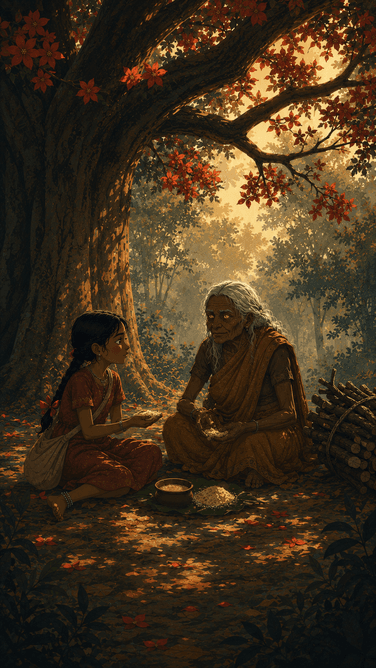
"I am so afraid that my knees are talking to each other," said Champa, because it was the truth. "But my brother is sicker than I am afraid. So I am going."
The old woman laughed like dry leaves. "Straight on, then, little cowherd. And listen. When you come to a place where you cannot go on at all — do not run, and do not weep. Stand still, and ask."
When Champa turned to thank her, there was nobody under the trees. Only the firewood, neatly stacked, and the wind moving in the red flowers overhead.
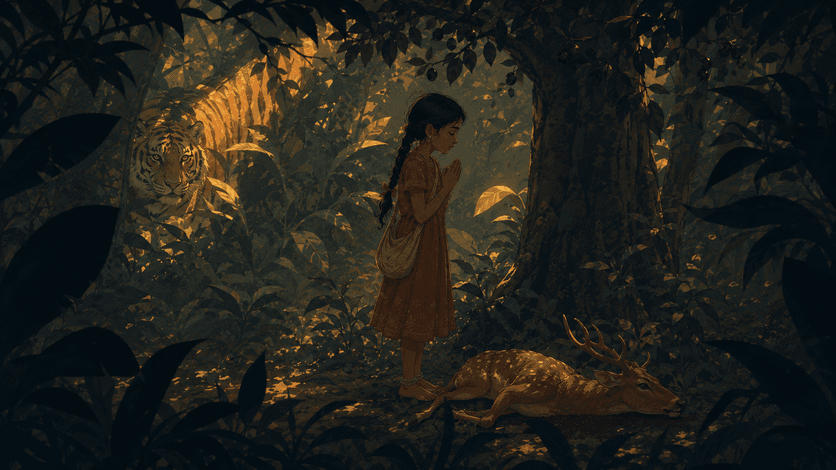
All the second day, she was followed. Not on the path — beside it. A pressure in the leaves. A silence that moved when she moved and stopped when she stopped. Once, through a gap in the undergrowth, she saw stripes, like sunlight through a broken fence, and then nothing at all. At noon she came upon a fresh kill, a chital deer, laid under a jamun tree — and she was, by then, very hungry. She stood over it for a long moment. Then she folded her hands.
"This is the Old King’s table," she said aloud, "not mine." She walked around it and on, and behind her the whole forest seemed to let out a breath.
By the evening of the third day the trees thinned, and there it stood against the first stars: Munda Pahar, the bald hill, its stone crown pale as an old man’s forehead. She climbed in the dark and skinned both knees doing it, and when the full moon lifted itself over the rim of the world, the whole bare summit answered it. Everywhere across the rock, buds were opening hundreds of them — and their scent was the scent of first rain on hot ground. The chandkali.
Champa folded her hands to the hill and asked. Then she took one bloom — one only, though a garden of them shone around her — wrapped it in a wetted cloth, stood up, and only then did the arithmetic catch up with her.
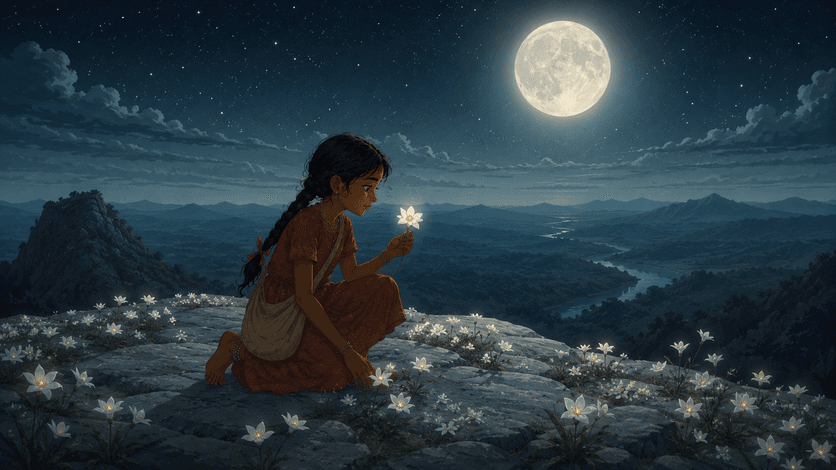
The moon was risen. Sunrise was one night away. Between her and Bhola lay three days of forest. For one long, cold breath, the flower in her hand was the most useless, beautiful thing in the world. She wanted to run down the hill screaming.
She wanted to sit where she was and howl. “Stand still, and ask”- she remembered the old lady
Champa stood still. She turned to face the black ocean of trees below, held the flower against her heart, and asked — loudly, plainly, the way she said everything.
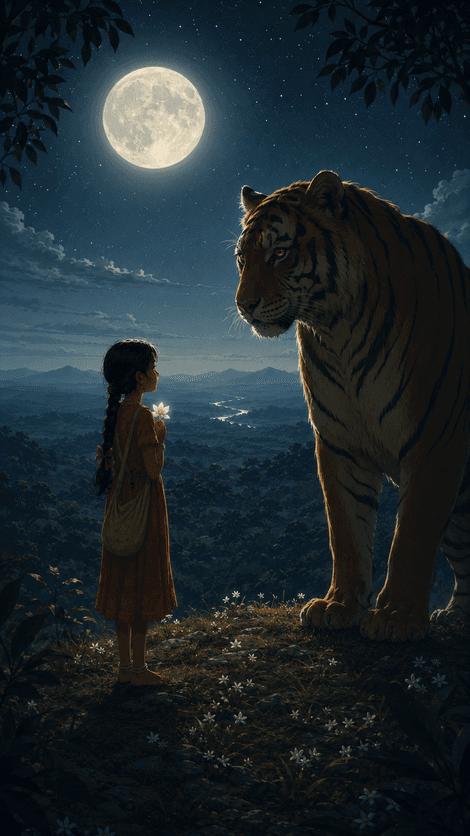
"Old King of the sal forest! I have walked your kingdom for three days. I took nothing I was not given. I touched nothing on your table. I told no lies under your trees." Her voice cracked, and she let it. "My brother is six years old, and he is forgetting how to breathe. Your forest is three days wide and I have one night. I cannot cross your kingdom in time. But you can. I am asking."
For a moment there was nothing but wind on bare stone.
Then the grass at the summit’s edge parted without a sound, and the moonlight found him. He was old. He was enormous. His stripes lay over him like black rivers across a golden country, and his eyes were two steady lamps, and he was so beautiful that Champa’s fear simply forgot how to work. The Old King of the sal forest looked at the small girl with the flower for the space of ten heartbeats. Then he turned side-on to her and glanced back over his own shoulder. There is no graceful way to climb onto a tiger.
Champa begged his pardon, took two fistfuls of the loose fur of his neck, and scrambled up as if he were the washerman’s bullock. The Old King bore it with the patience of a very old king. Then he poured himself down the hillside, and the night tore open.

Afterwards, Champa could never tell it properly. She said the forest opened like a book being read very fast. The great paws made a sound like muffled drums that never once missed their beat. Deer stood in the fern and did not run. At the Bagmati he did not even slow; he took the river in three leaps, sandbar to sandbar, and the water remembered them only as rings. They passed sleeping villages where the dogs, for once in the long history of dogs, said absolutely nothing. Fireflies streamed by like sparks off a grindstone, and the moon ran with them, keeping pace between the branches. Somewhere around the second river, Champa stopped being afraid, and after that it was all wonder. She pressed her cheek into the warm fur, kept the flower against her heart, and the night went past like water.
The eastern sky had turned the colour of a dove’s breast when they broke from the last trees — and there lay the fields of Simariya, and the temple, and, keeping the dawn watch on the temple steps with his bow of buffalo horn, Veer Singh the huntsman.
He saw what any huntsman would see: the Old King of the forest charging the village at a flat gallop with something clinging to his back. The bow came up. The arrow came back to his ear.
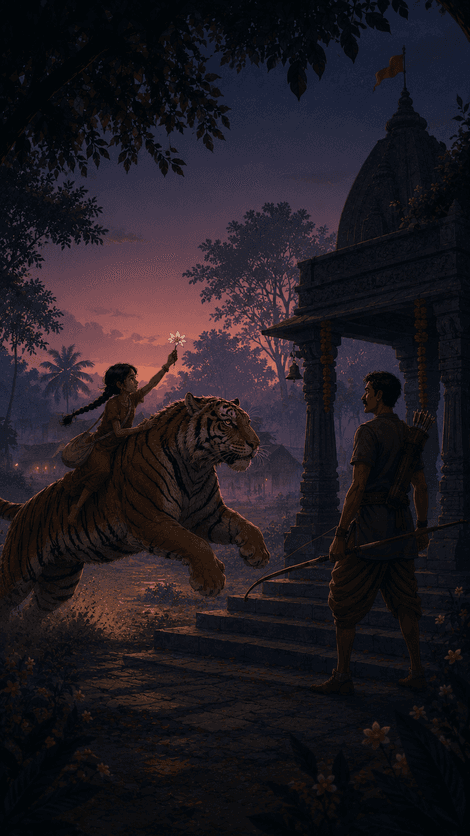
"VEER SINGH!" Champa’s voice cracked across the fields like a whip. "It is Champa! Look with both eyes before you loose!"
The huntsman looked with both eyes. What both eyes saw, his hands refused to believe, and the arrow’s point wandered down, and down, until it aimed at his own astonished feet. The Old King went past him close enough to touch, and did not trouble to glance at him.
They came up the village street out of the grey dawn like a rumour come true. Doors banged open. And Vaidya Sadanand, who had sat awake all night beside the prince because there was nothing else left to do, came out onto the steps — and to his everlasting honour, he did not waste a single second on amazement.
"The milk!" he roared. "Warm the milk!"
The east was pinking over the mango tops. Champa slid down from the Old King’s back on legs that had forgotten how to be legs, and put the flower, wet cloth and all, into the vaidya’s hands — hands that shook and did not spill. Petal by petal, the chandkali went into the warm milk; drop by drop, the milk went onto burning tongues. One petal for the prince. One for Bhola. One for the potter’s twins, one for the weaver’s daughter — and the flower, as if it understood its work, did not run out until the children did.
The sun cleared the mango trees just as the last child swallowed. And the Old King? By the time the village found its voice and its courage, he was already a ripple moving away through the young rice. At the edge of the fields he paused, once, and looked back — not at the village. At Champa. Then the grass closed behind him, and he was gone.
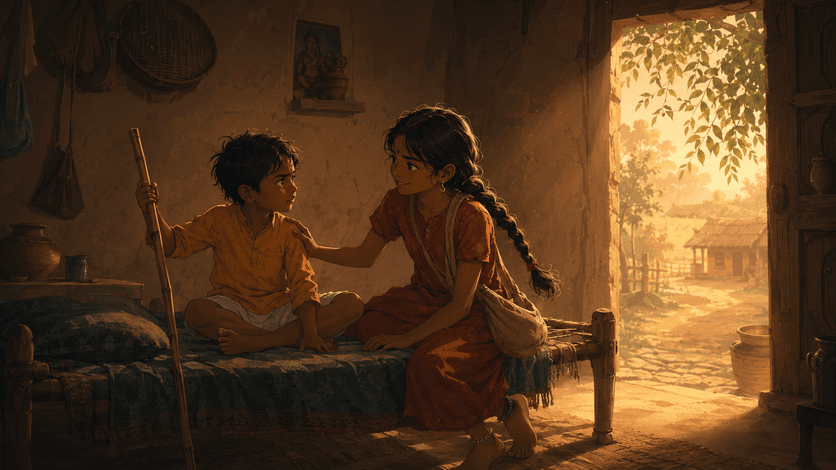
By evening, the shivering had stopped in every house it had entered. Bhola woke, looked around, and demanded in an offended voice to know who had moved his stick. The little prince sat up and made Veer Singh describe the tiger four times and corrected him twice.
When the prince was strong again, the king held court under the great pipal beside the temple, and Champa was brought before him with her. There were trays of gold. There was talk of land, of pearls, of a place at the palace. Champa folded her hands. "Maharaj, we keep cows. Gold confuses cows. But I will ask for two things, if I may."
"Ask for ten," said the king, who had spent three nights learning what things are truly worth.
"First — let the Old King’s kingdom be his. From the Bagmati to the blue hills: no axe, no bow, no snare, no torch. Not now, not ever. Let it be cut into copper, so that it outlives every one of us." "It shall be cut into copper," said the king. "And the second thing?" "A milk cow," said Champa, "for an old woman who lives under the big semal tree, one day into the forest. She is hungrier than she looks."
So the copper plate was engraved and hung in the Shiva temple, where it stayed for as long as anyone kept count of years. And the king’s men led a fine cow into the forest, to the great semal tree — and found no hut there, and no old woman, and no sign there had ever been either. Only, pressed deep in the dust between the roots, the print of one enormous paw. Being sensible men, they left the cow near the semal anyway and came home quickly. Before the whole court, the king spoke once more. "Let it be written on the same copper that Champa, daughter of Simariya, shall from this day be called the Tiger Rider of Trihut."

The drums said it, then the people said it, and after that there was no getting rid of the name.
To this day — so the grandmothers of those parts insist — the cowherds along the forest’s edge pour the first cup of the morning’s milk at the little forest shrine.
The old sal forest still stands unbroken between the rivers and the hills, which in this world is its own kind of miracle. And on certain full-moon nights, if you happen to be walking the white river sand at exactly the right hour, you may find two lines of prints running side by side — one set small and bare, the other big enough to sit in — going down to the water and never coming back.
The grandmothers do not explain it. They only smile, and say what everyone in Trihut has always known: that in the old days, this land had two kings — and both of them knew her name.