
THE JACKAL WHO ATE ALONE
Long ago, in the sal forests that lie below the Vindhya hills, there lived a jackal named Ranga. Ranga was not the swiftest animal in that forest, nor the strongest, nor the one with the sharpest teeth. He was, however, the one who thought the most. And because he thought a great deal, he had come to a conclusion that troubled him: alone, he would never eat well. He would live on beetles and bones and whatever the vultures left behind, and he would die thin.
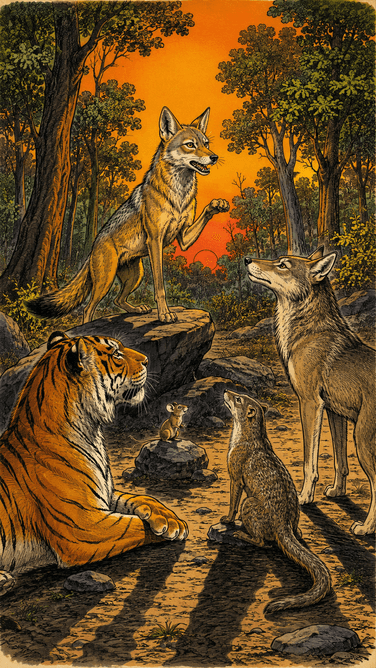
So one evening, when the light had turned the colour of turmeric, Ranga went walking through the forest and made an offer to four others.
To Bhairav the tiger he said, "You are the strongest creature here, but even you cannot bring down what you cannot catch."
To Kaalu the wolf he said, "You can run all day, but what good is running if there is nothing at the end of it?"
To Nakul the mongoose he said, "You see everything and you fear nothing, and yet you eat eggs and lizards."
And to Tiku the mouse he said, "You are so small that nobody notices you. That is not a weakness, my friend. That is a weapon." Then he told all four of them together: "In the meadow by the Ketaki river there is a great sambar stag. He is too fast for one hunter and too heavy for one throat. But five of us, each doing the one thing he does best — five of us could eat for a week."
The four looked at one another. It was a good argument, and they knew it. They hunted at dawn.
Tiku the mouse went first, because nobody sees a mouse. He crept through the wet grass to where the stag lay sleeping and, with two quick bites, cut the tendons above its hind hooves.
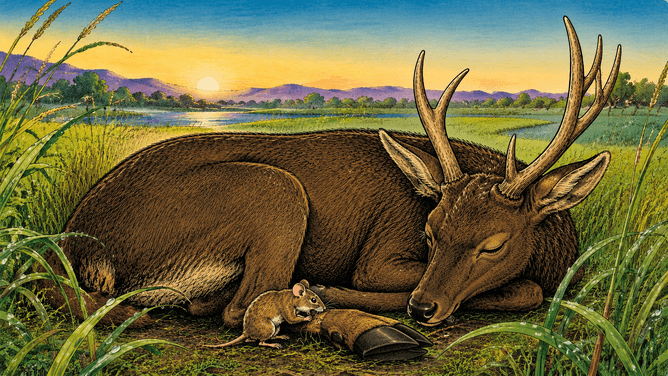
The stag woke and leapt up — and staggered. Kaalu the wolf came howling from the east, driving it away from the open ground and towards the trees.
Nakul the mongoose ran ahead along the riverbank, checking the reeds, for a mongoose sees what others miss, and he wanted to be certain no leopard was waiting to steal what was not his.
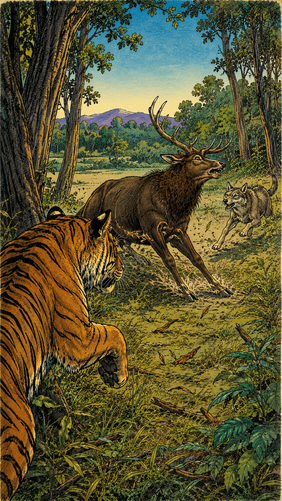
And when the stag turned, exhausted, at the edge of the sal trees, Bhairav the tiger was already there. It was over quickly. The five of them stood around the carcass, breathing hard, well pleased with themselves. The morning was hot and they were all bloodied and filthy.
"The river," said Bhairav. "Let us wash first and eat afterwards, like civilised creatures."
"Someone must stay and guard it," said Nakul.
"I will stay," said Ranga at once. "I am the slowest bather among you anyway."
The four went down to the water, and the jackal was left alone with more meat than he had seen in his whole life.
Ranga walked around the carcass once. Then he walked around it again.
A week, he thought. A week of eating for five. Or a month of eating, for one.
He knew perfectly well that he could not fight them. A tiger would break him with one paw. A wolf would outrun him.
Even the mongoose, small as he was, would tear his throat out before he understood what had happened. But Ranga had watched all four of them for a long time. And he had noticed something that none of them had noticed about themselves.
Each one of them, he thought, carries the thing that will defeat him. I do not have to bring a single weapon. I only have to hand each one his own.
He sat down beside the meat and arranged his face into an expression of deep and sorrowful thought. Bhairav returned first, shaking water from his coat. Ranga did not look up. He sighed.
"What is the matter with you?" said the tiger.
"Nothing. It is only that Tiku said something before he went to the river, and I cannot get it out of my head." Ranga paused, as though regretting he had spoken.
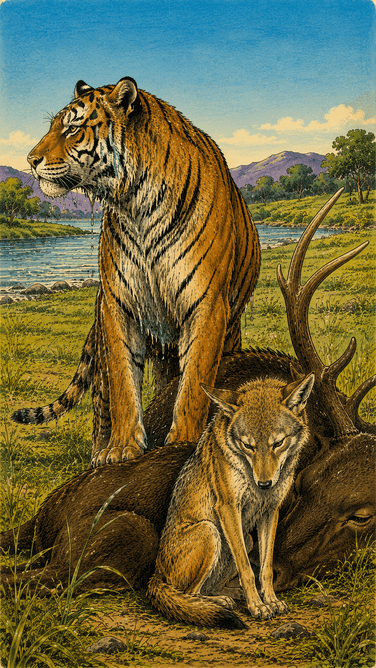
"He was laughing. He said — forgive me, Bhairav — he said the tiger has not truly hunted today. He said, I crippled the stag, I did the work, and the striped one only walked up afterwards and put his mouth on a dying animal. He said you are eating today out of a mouse’s charity."
Bhairav went very still.
Now, everything in the tiger’s body knew this was probably a lie. But the tiger had spent his whole life being the strongest thing in the forest, and a creature like that does not fear death half so much as he fears being laughed at.
"Then let the mouse have it," said Bhairav coldly. "I do not eat charity." And he turned and walked into the forest to kill something himself, so that no one could say a word about it.
Tiku came scampering up next, wet to the whiskers. "You should have heard them at the river," said Ranga sadly.
"All three of them, laughing about you. Kaalu said, ‘What shall we give the mouse? A hoof? An ear?’
And the mongoose said, ‘Give him a hoof, he will be full for a month.’ They said you did nothing. They said a mouse is a joke with legs."
Tiku’s whiskers trembled. He was very small, and he had been very brave that morning, and he had been waiting all the way from the river to be told so.
"Then I do not want their hoof," he said, in a voice that cracked. "I do not want anything from them."
And he ran into his hole and pulled the earth shut behind him, and would not come out even when he was hungry. Kaalu the wolf arrived, and found Ranga standing rigid, staring into the trees, trembling all over.
"Run," Ranga whispered. "Run now. The tiger has gone to fetch his brothers. He says the stag was his kill and his alone, and that anyone found at this carcass when he returns will be counted a thief. Kaalu, he is bringing his whole family." The wolf looked at the trees. He looked at the meat. He could fight a tiger, perhaps, for a little while. He could not fight four.He ran, and he did not stop running until the river was far behind him.
Last of all came Nakul. Ranga knew that the same trick would not work three times, and it would certainly not work on a mongoose. So he tried something else. He did not whisper. He did not sigh. He stood up on the carcass, puffed out his chest, and looked down at Nakul with the calm of a creature who has already won.
"You are late," said the jackal. "The tiger came and claimed this meat. I sent him away. The wolf came and challenged me for it. I sent him away also. The mouse has gone into the ground and will not come out." He bared his teeth pleasantly. "You are welcome to your share, Nakul. You need only fight me for it, as they did."
Nakul the mongoose was the most sensible animal in that forest, and he did not believe a word that anyone told him. So he did what a sensible animal does. He ignored the jackal entirely and looked at the evidence. The tiger: gone. The wolf: gone. The mouse: gone. Something had emptied this meadow. And Nakul thought I have known this jackal for years and I never once suspected he had it in him. But there is the meat, and there is nobody left to eat it, and he is standing on top of it, unhurt. He weighed a meal against his life, the way he weighed everything, and he found that the meal was lighter.
"Keep it," said Nakul, and he went away to hunt crabs in the shallows.
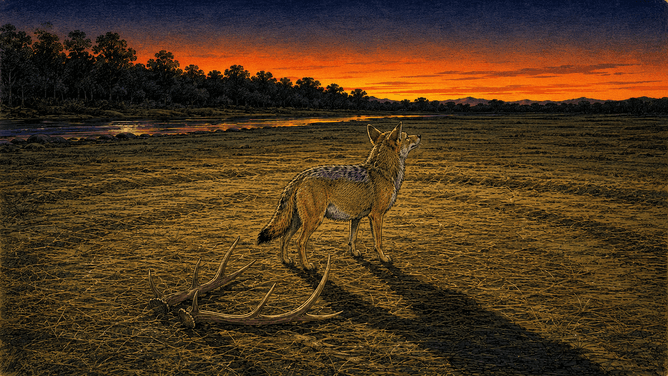
So, the jackal ate. He ate all that day, and the next, and the day after that, until the meat turned and the flies came and even, he could not stomach it. It was the greatest feast of his life, and he ate every mouthful of it by himself, in an empty meadow.