
First, I Count, Then I Move
King Virendra was a fast man. He gave orders quickly. He walked quickly. He liked things done at once. He believed a King does not have time to take a breath.
His small daughter, Princess Ila, was not fast at all. Before she picked a flower, she counted to three. Before she crossed the courtyard, she counted to three. Her grandmother Rajmata Sumitra had given her a string of counting beads, and Ila slid them through her fingers wherever she went.

"First I count, then I move," Ila would say.
The King loved her dearly. But he thought the beads were a child’s small game.
"Count faster, little one," he would tell her jokingly, and the court agreed with the King. Whenever the king gave orders, the ministers hurried. The servants ran. The messengers dashed. Everyone moved fast, and the small princess walked among them one bead at a time.
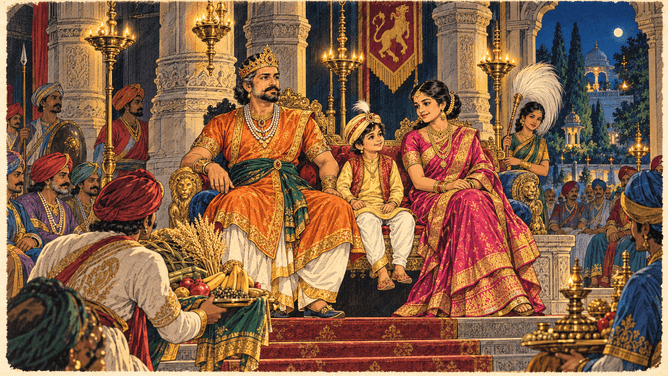
One night the great hall was full for the harvest durbar. The whole court had come in their finest silks. The King sat proud, with little prince Anuj beside him. Lamps glowed on the stone pillars. The garden door stood open for the cool air.
The King was happy.
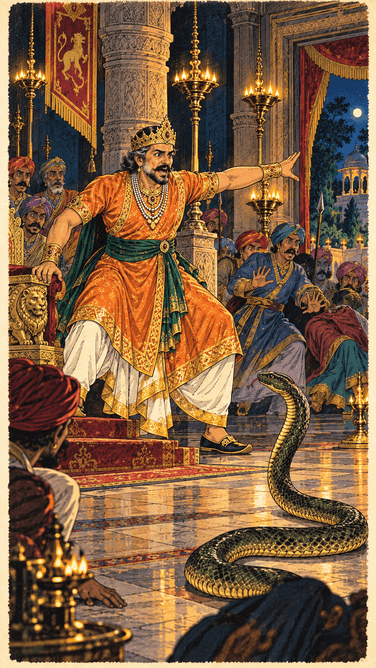
Then, from behind a pillar, a long snake slid onto the middle of the floor.
The King did what he had always done. He leapt to his feet. He filled his chest and he shouted, "Guards! The door! Everyone out!"
But his voice was one shout among a hundred. The Queen was screaming. The ministers were leaping onto the benches. No one could hear a single word he said.
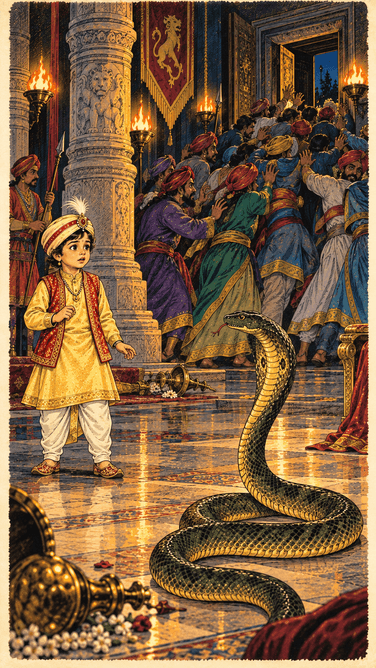
The whole court rushed at the one small doorway. They pushed. They shoved. They jammed so tight that nobody got through at all.
And the King shouted louder. The louder he shouted, the worse it grew. The noise frightened the snake. It reared. It flicked this way and that. And then it turned toward little Anuj.
Anuj stood alone on the open floor, too scared to run, too scared to breathe.
The King shouted for the guards. He shouted for the door. He shouted his son’s name.
Nothing came. His voice was lost in the storm he had helped to make. For the first time in his life, King Virendra did not know what to do.
Then, through all the noise, the King heard something small.
It was his daughter’s voice. Ila stood near her brother. She did not shout. She did not run. She began to count.
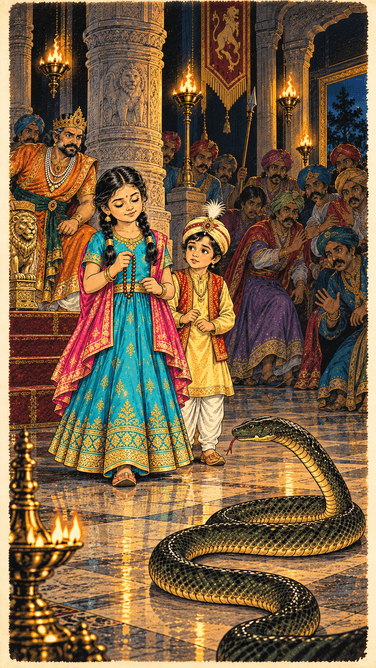
"One," said Ila, slow and clear. She slid a bead. "Two." Another bead. "Three."
Anuj heard his sister. His shaking stopped. He stood still.
The people nearest Ila heard her too. Their pushing slowed. Their shouting fell away. They began to count under their breath along with her. The King stood with his mouth open. His own shout died in his throat.
Here was the thing he had laughed at. A child, counting. And it was doing what all his shouting could not.
So the King, who had never slowed in his life, closed his mouth and listened.
"Four… five… six…" came the soft voices, and King Virendra began to count too.
The count spread across the hall like a cool wave. The Queen went quiet. The ministers climbed down. Soon the whole great hall was still, every person counting softly, no one moving at all.
And with nothing thrashing, nothing stamping, nothing shouting, the snake had no storm to fear. It lowered its head. It turned. It glided out through the open garden door, into the dark, and was gone.
For a moment the hall did not dare to breathe. Then the King crossed the floor. He had shouted himself hoarse, and his shouting had helped no one. He knelt before his small daughter, right there before the whole court, and he took her counting hand in his.
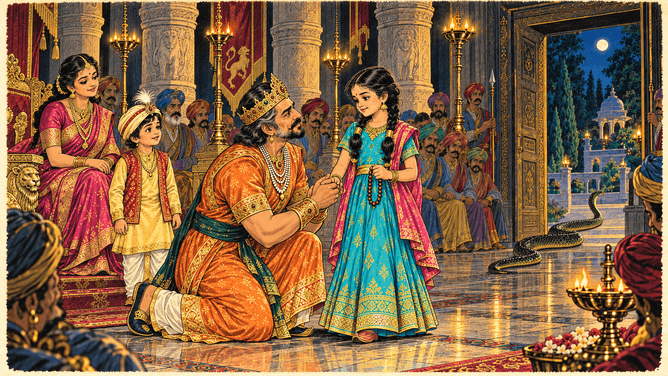
"I was wrong," said King Virendra. "A king has all the time in the world to count."
He slid one bead through his own fingers, slowly. "First we count," said the King. "Then we move."
The beads lay warm in the King’s hand, and the garden door stood open on the quiet night.