
LAST NIGHT OF THE SAL TREE
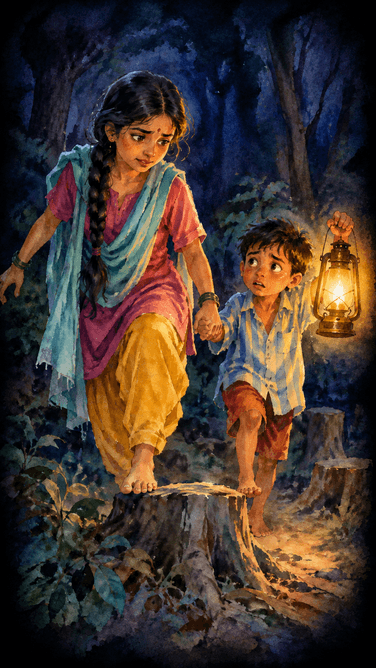
Munni stepped over a stump, then another. Bittu’s hand was small and hot inside hers. He was six. He held the lantern up as high as his arm would go.
"Slower," he whispered.
"We cannot go slower," said Munni. "The truck comes up the Bhimgarh road at first light."
The path was the one they took every day for firewood. But at night, it was not the same path. Every leaf seemed to be watching. They passed the mahua stump. The mahua had given sweet flowers every spring, and Munni had climbed it.
They passed the jamun stump. They passed the tall arjun by the stream, which was also a stump. Munni had climbed all three. Now she stepped over them. At last, the lantern light fell on a wide, rough trunk. It was wider than anything else in the forest. One summer, six children had stood around it and held hands, Munni and Bittu among them, and their fingers had not met. They had always fallen one child short.
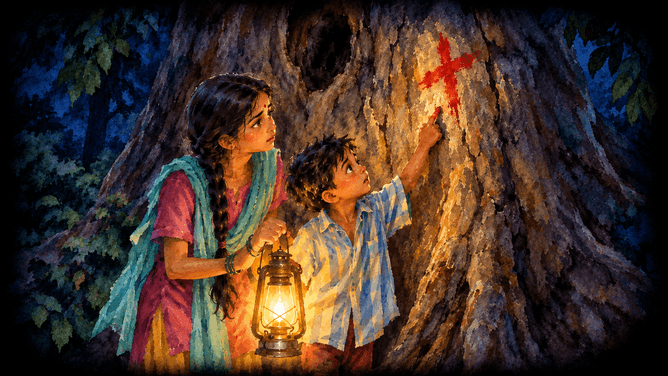
And there, at the height of Munni’s head, was a cross of wet red paint. Bittu touched it. His finger came away red. "Baba said twenty rupees a foot," he whispered. "He said this one alone will bring two thousand."
"I heard him," said Munni.
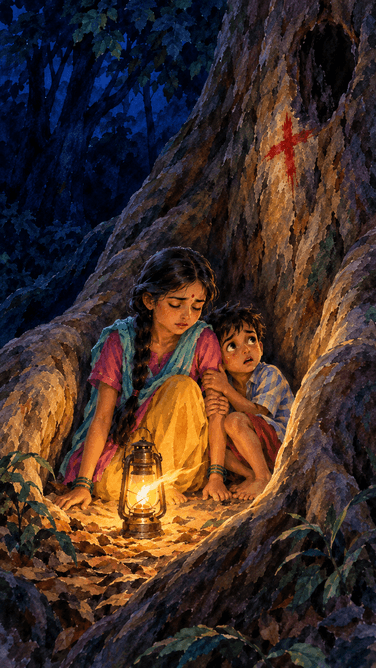
She had heard her father, Ramdas, counting the money at the table that evening. He had looked pleased. They sat down between two great roots. Bittu set the lantern on the ground. The light made a small yellow room around them. Beyond it, everything was black.
"Now what?" whispered Bittu.
"Now we do what Aaji said," said Munni. "Not in the day. In the day, it is only a tree. But at night, if you sit very still and your heart is quiet, it will speak."
"Nobody has ever sat that still."
"You are the one who said we should come and say goodbye," said Munni. "So sit."
So they sat. It was Chaitra, and the night was warm. An owl called somewhere above. A cricket sang. Munni closed her eyes. She breathed slowly, the way Aaji had taught her to breathe when she was frightened.
"You came," a voice spoke.
It came up from the ground, through the roots, into her bones. It was low and slow, like wind moving through a cave. Bittu grabbed Munni’s arm. Munni’s own heart was pounding, but she made herself speak.
"We came to say goodbye," she said. "They are cutting you tomorrow."
"I know," said the sal tree. "I felt the paint. It is cold."
Bittu found his voice. "Are you scared?"
The sal tree was silent for a long moment. The lantern flame bent, though there was no wind.
"I am three hundred years old," it said. "I am not scared of falling. I am scared of something else. I am scared that nobody will know what I knew. So I am glad you came."
"Sit close," said the tree. "I am going to tell you a story. It is a long story, because it is a long life. Will you listen until the end?"
"Yes," said Munni.
"Yes," said Bittu, and he moved closer.
"I was not planted by a man," said the tree. "I was planted by a bird.
"Three hundred years ago, I was a very small seedling. Two leaves, no taller than your finger. I do not know who planted me; the neighbours told me a hornbill dropped me here. Those big trees above me took all the sunlight. I was hungry and thin. I thought I would die.
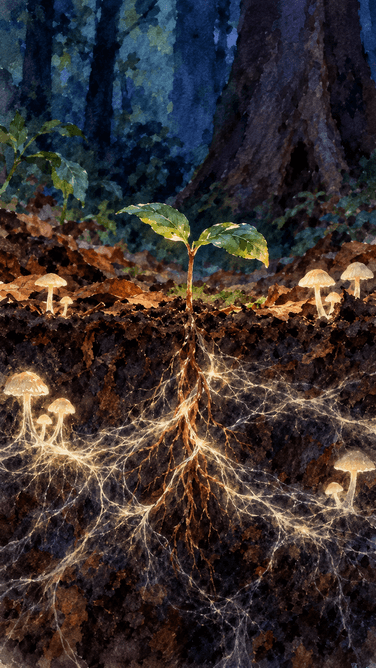
"Then one night, I felt something touch my roots. It was soft and white and thread-like. It was a mushroom. Not the cap you see above the ground, but the part beneath, which spreads for miles like a net.
"’Who are you?’ I asked.
"’I am Kavak,’ said the mushroom. ‘I live in the dark. I cannot make food from sunlight, as you do. But I can find water and salt from very far away. Give me a little of your food, and I will bring you water.’
"So, we made a bargain. Every day I sent a little food down my roots. Every day Kavak sent up water and minerals from deep in the earth. That is how I lived. I lived because a mushroom, which you would step on without looking, kept me alive.
"Kavak is still here. Feel the ground under your hand, Munni. Feel how it is soft and springy. That is Kavak. He is under this entire forest.
"Every tree you see is holding hands with every other tree, under the ground, through him. When one tree is sick, the others send it sugar through Kavak’s threads. That is how a forest works. Nobody is alone."
Munni pressed her palm flat on the earth. It was cool and damp. She had never thought about what was under it.
"By my fiftieth year, I was tall," said the tree. "And I was proud of it. I thought I had grown by my own strength. I had forgotten the bird and the mushroom.
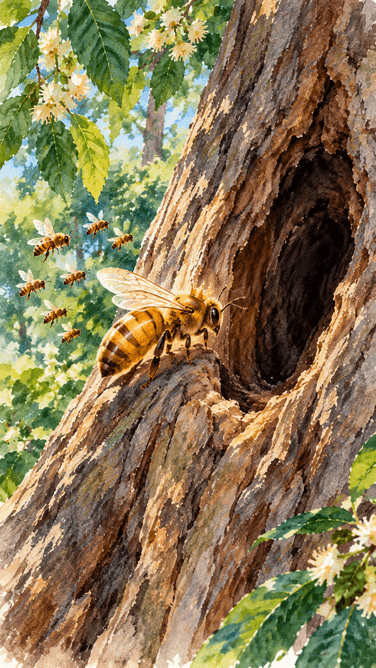
"One day, a bee came and landed on my bark. She was a big, golden bee. She walked in circles and looked at my hollow, where a branch had broken off in a storm.
"’I am a Queen Bee,’ she said. ‘My old hive was in the tree that fell last month. My daughters and I need a home. May we live in your hollow?’
"I did not want them. I thought they would be noisy. I said, ‘What will you give me for it?’
"Queen Bee laughed. ‘Foolish tree,’ she said. ‘You have flowers, do you not? Who do you think carries your pollen from your flowers to the flowers of the sal tree across the stream? Who makes your seeds? Not the wind. Us. Without us, you will make no seeds at all.’
"I had never thought about it. I said yes at once.
"So the bees moved into my hollow. From that day, they flew from me to the mahua tree beside me. They flew from the mahua tree to the jamun beyond her. They flew from flower to flower, and everywhere they went, fruit followed.
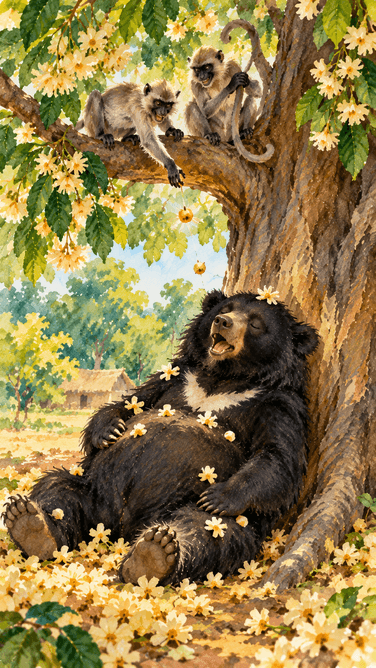
"Because the bees visited the mahua tree, she was covered in sweet flowers every spring. Because of her flowers, the bears came. One of them was black and shaggy with a white V on his chest. Every spring he came to eat the fallen mahua flowers until his belly was round. Then he would sit against my trunk and sleep in the sun. He snored so loudly that the langurs would throw seeds at him.
"Now, because bears were in the forest every spring, the people of Bhimgarh stayed out of it. They were afraid of them. And because the people stayed out, the deer could give birth in peace.
"And because there were many deer, there was food for the leopard. And because there was a leopard, the wild pigs did not grow too many and dig up your father’s fields.
"Do you see, children? A bee asked me for a home. And because I said yes, your father’s field was safe from pigs. That is how far one small yes can travel."
"But the mahua is a stump now," said Munni quietly.
"Yes," said the tree. "That is the next part of the story, and it is not a happy part. The men came on a Tuesday. I remember because the langurs had just finished their morning fight. They came with a saw that screamed. I had never heard a sound like it. Every bird in the forest rose into the air at once. The sky went dark with wings.
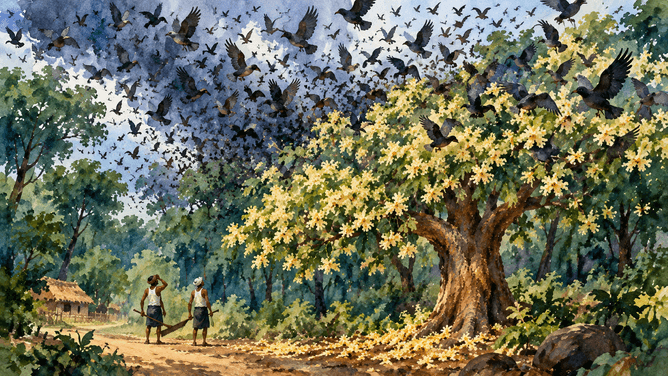
"They cut Mahua Mausi first. She was closest to the road.
"She did not scream. Trees cannot. But I felt her. Through Kavak’s threads, under the ground, I felt her go cold. It took an hour. Then she fell, and the earth shook, and she was gone.
"That night, Queen Bee’s granddaughter came out of the hollow. She was the queen now. She was very upset.
"’Where will we go in the morning?’ she asked. ‘Half our flowers were on the mahua tree. We cannot feed the hive on your flowers alone. We must fly further.’
"’Then fly further,’ I said. ‘And come back.’
"She was silent. Then she said, ‘Some of us will not come back. We will find a new forest, and we will stay there.’ And that is what happened. Every day, fewer bees returned. The hive grew quiet. By the end of the month, it was empty.
"Now, children, no bees. So who carried the pollen to the jamun tree?"
"Nobody," said Bittu.
"Nobody. That spring, the jamun tree flowered, purple and beautiful, and almost no fruit came. Just a few. Not enough.
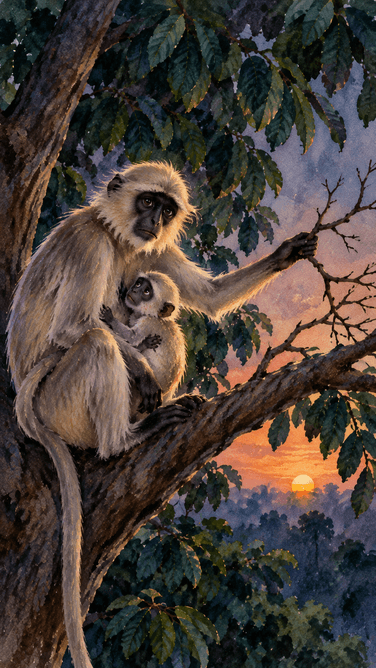
"There was a langur mother in this forest. She had a baby who clung to her belly. Every evening she came to the jamun tree with her family. That was their dinner. Every day, all summer. That summer, they came and found nothing. I watched her baby grow thin. I watched her climb the jamun tree again and again, looking for fruit that was not there.
"One evening, she climbed onto my branch and sat where the owl sits now. She looked at me with her old grey face.
"’We are leaving,’ she said. ‘I am taking the children to the hills. There may be food there. I do not know.’
"’You were born in this forest,’ I said.
"’Yes,’ she said. ‘And my children will not be.’
"She left at dawn. I never saw her again. I do not know if the baby lived."
Munni found that her eyes were wet. She did not wipe them. Bittu had put his thumb in his mouth, which he had not done for a year.
"Then they cut the jamun," said the tree. "Then the arjun. The arjun stood right at the edge of the stream. Do you remember him, Munni? He was tall and pale, with bark like silver paper. You climbed him once and could not get down, and your father had to come."
"I remember," said Munni.
"His roots went down into the bank of the stream. They held the soil together, the way your fingers hold a fistful of sand. Nobody could see those roots. So, nobody thought they mattered. They cut him in Jyeshtha, before the rains. For a month, nothing happened. The stump sat there. The bank looked the same.
"Then the monsoon came. The first big rain fell on a night much like this one. It fell hard, the way it does. And the bank of the stream, with no roots to hold it, simply slid into the water. I heard it go. A long, wet, tearing sound.
"By morning, the stream was red. Not with blood, but with mud. Thick red mud, from bank to bank. There were small fish in that stream. Silver ones, no longer than your thumb. Fish breathe by pulling water through their gills. But this water was mud. They breathed mud. By afternoon, they were floating.
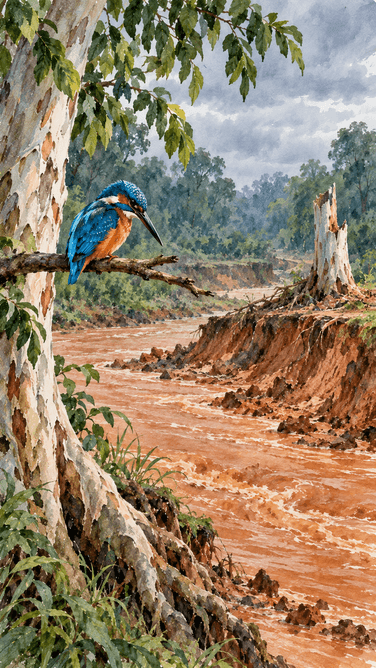
"There was a kingfisher who lived on the arjun. She was blue like a piece of sky that had broken off. She ate those fish. Every morning she sat on a branch, dropped like a stone, and came up with a silver fish in her beak. After the arjun fell, she sat on my lowest branch instead. After the stream turned red, she sat there and did not dive. She sat for three days.
"On the third evening, she said, ‘There is nothing to dive for,’ and she flew away down the valley. That is what one tree does when it falls. Not one thing. A hundred things. The men look at a stump and see one tree gone. I look at a stump and see the bees, the bear, the langurs, the fish, the kingfisher. All gone. All from one Tuesday."
"Now I will tell you something about your father," said the tree.
Munni went stiff. "What about him?"
"Do not be afraid. He is not a bad man. He is only a man who cannot see under the ground. Nobody taught him. So I will teach you, and you can teach him.
"Last year, the rains came late to Bhimgarh. Do you remember?"
"Yes," said Munni. "Baba was worried. The seedlings dried. He did a puja."
"He blamed the gods. Yes, I heard him. He stood at the edge of the forest and shouted at the sky. Munni, hold your hand near the lantern. Feel the warmth on your palm?
"Now put your hand against my trunk. Feel how cool it is?"
Munni did. The bark was cool and damp, like a clay pot in summer.
"That coolness comes from water. Every leaf I have, and I have many thousands, breathes out a tiny bit of water every day. You cannot see it. But it rises. From every tree in this forest, it rises, and it gathers above us, and it becomes a cloud.
"A forest makes its own rain. Not all of it, but a great deal. The clouds that fall on your father’s field were born in these leaves. Now count the stumps between here and the village."
Munni thought. "I do not know. Many. Twenty? Thirty?"
"Forty-one," said the tree. "Forty-one trees. Millions of leaves. Millions of tiny breaths of water that no longer rise. And so the cloud above this forest is smaller than it was. And so the rain comes later. And so your father shouts at the sky.
"There is more, and this is the part that frightens me. Where a tree stood, there was shade. Where there is a stump, there is bare earth. Bare earth bakes in the sun. It grows hot.
"Hot ground makes hot air. Hot air pushes the clouds away. So the fewer trees, the less rain. The less rain, the fewer trees can grow. And round and round it goes, like a bullock walking in a circle around the well, except the well is going dry.
"It does not stop by itself, Munni. Someone has to stop it. A tree cannot. A tree can only stand and breathe. Only a person can plant."
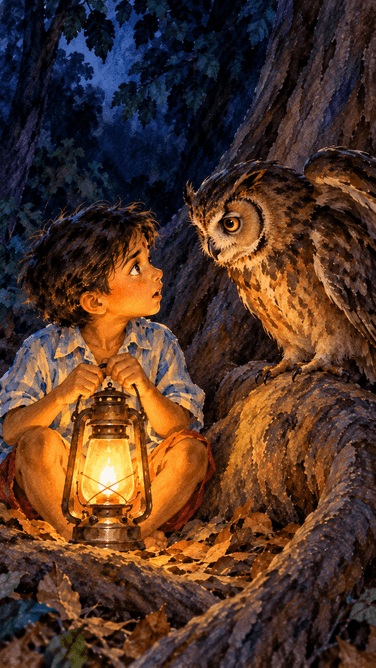
Above them, the owl called again. This time it was close.
"That is Ulook," said the tree. "He is listening. He is the last owl in this part of the forest. Ulook, come down."
There was a rush of wings. A large brown owl landed on the root beside Bittu. Bittu did not move. The owl’s eyes were the colour of lamp oil.
"He does not talk," said the tree. "But I will tell you what he does. Every night, Ulook flies to the edge of the village. He sits on the roof of your grain store. When a rat comes out to eat your rice, Ulook takes it. Four, five rats a night. Every night, all year.
"Your father has never once seen him. If Ulook goes, the rats stay. In one year, they will eat a quarter of your grain. Your father will never know why."
Ulook blinked, once, slowly. Then he lifted off into the dark.
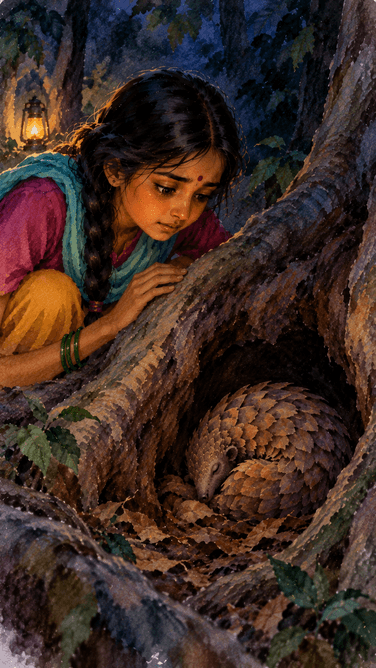
"Now look there, between the roots. Do not shine the light. Just look."
Munni looked. Something was curled in the hollow between two roots. It was covered in scales, like a pinecone, like an old warrior’s armour. It was fast asleep.
"That is a pangolin," said the tree. "She is shy and she is slow and she is the gentlest creature in this forest. She eats ants and termites. Nothing else. A thousand termites a night. Now think, Munni. What are the beams of your house made of?"
"Wood," said Munni.
"And what eats wood?"
"Termites," said Bittu at once. He was proud that he knew.
"So a creature you have never seen, who sleeps under a tree you were told is only a tree, keeps the roof over your head. Do you understand now, children? The forest does not have useless things in it. There is no such thing as ‘just a bug.’ Every single creature is holding up some part of the world. You only find out which part when it is gone."
The sal tree went silent. Far away, the first bird began to sing. The black between the trees was turning grey. Now the sky was pale. Munni could see the shape of the tree above her, its great crown against the dawn.
And something was falling from it. Small brown things, spinning as they came down. They landed on her hair, on Bittu’s face, on the lantern. She caught one. It had a seed at one end and five thin wings at the other, like a tiny dry flower.
"I have been dropping them all night," said the tree. "You did not notice. You were listening.
"I made more seeds this year than I have ever made. I think I knew. The wind has carried some across the stream, where the men have not gone yet. But the wind is not enough. Wind is careless.
"So I am asking you. Gather them. As many as you can hold. Take them home. And in the first week of the rains, plant them. Along the stream, where the arjun was. By the mahua stump. At the edge of your father’s field. Wherever a stump is, put a seed.
"Do not tell your father why. He will laugh. Just plant them. In three years, he will have shade. In ten years, he will have rain. In thirty years, he will be an old man sitting under a sal tree, and he will tell his grandchildren that he planted it."
Munni stood up. She untied her dupatta and spread it on the ground. She and Bittu gathered seeds. They gathered until the dupatta sagged with them. Then Munni tied the corners together and hung it from her shoulder.
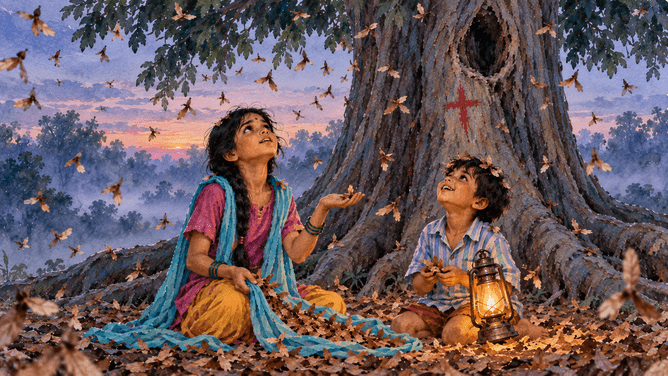
"Go," said the tree. "Go now. Do not watch."
"I do not want to leave you," said Munni.
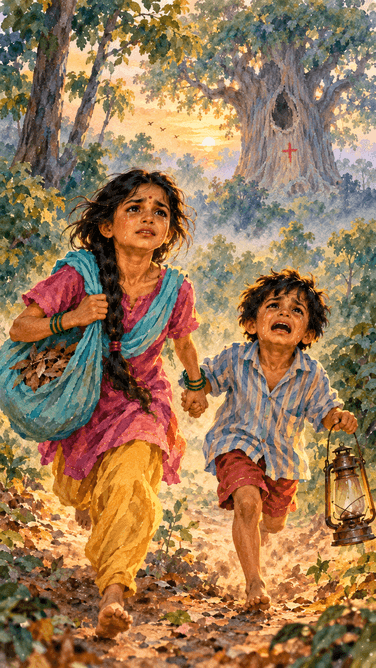
"You are not leaving me. You are carrying me. I am in your dupatta. I am in the hornbill. I am in the ground, holding hands with the other trees, and I will be there after they take my trunk away. A tree is not only its trunk."
Bittu was crying. Munni took his hand. She looked up one last time at the wide, cracked bark and the red cross.
"Tree," she said. "What is your name? You never told us."
The tree laughed, low and slow, like wind through a cave. "Nobody ever asked. I did not have one. Give me one."
Munni thought. "Aaji told us you could talk. So I will call you Aaji’s Tree."
"That will do," said the tree. "Now run."
They ran. Behind them, the saw began to scream.