
THE MARE WHO CHOSE HER RIDER
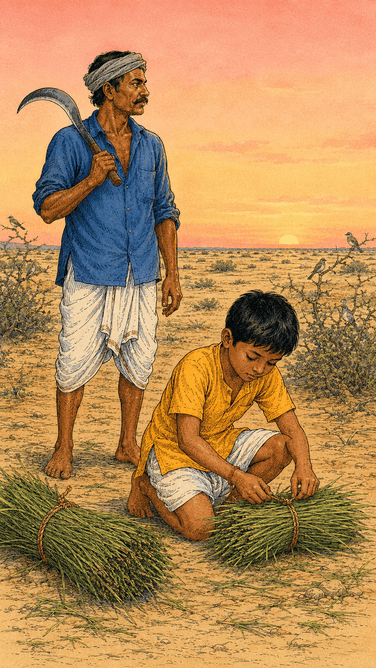
The sun was not yet up when Nathu went out to cut grass.
His father walked ahead of him with the sickle on his shoulder. The sand of Marwar was cold under their feet at that hour. Little grey birds were waking up in the thorn bushes and arguing about something.
They cut grass until the sky turned pink. Then Nathu’s father tied the bundles with rope. The two big bundles were for the Thakur’s stable. The small third bundle was Nathu’s own.
Nathu had cut that one himself, in the dark, before his father was even awake. It was his idea. A boy who wants something must get up earlier than everybody else, and Nathu wanted something very much.
He wanted to sit on a horse.
They walked to the Thakur’s stable, which had a high mud wall the colour of a chapati. Nathu’s father pushed the gate open with his knee.
Inside stood eleven horses of Marwar.
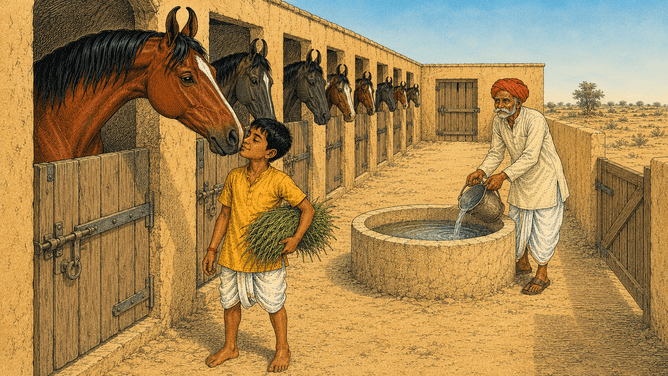
Nathu never got tired of looking at them. Their ears were the strangest and best thing he had ever seen.
The tips curved inward until they nearly touched, like two little hands about to clap. A bay mare put her nose over her door and blew at him. Her breath was warm on his cheek.
Kishan Singh, the stable master, was filling the water trough in the middle of the yard. He had a white moustache and one eye that had long ago closed for good.
"Grass in the corner," he said. "Don’t wander."
"Can I touch her?"
"Riding is for horsemen’s sons," said Kishan Singh. "Your work is grass."
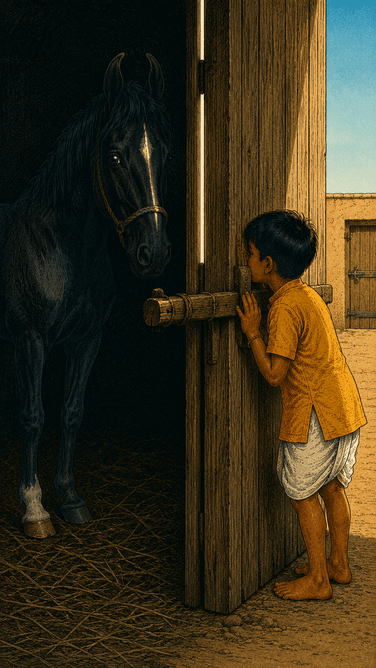
Nathu put the two big bundles in the corner. He kept his own small bundle under his arm. And on his way out, he stopped. There was a twelfth stall at the end of the row. Its door was shut all the way to the top, with a wooden bar across it. Nathu had never once seen inside. He put his eye to the crack between two planks.
A horse was standing in the dark. She was black. One of her front feet was white. She was so still that for a moment he thought she was made of stone. Then her eye moved and found his eye, and Nathu stepped back very fast.
"That is Bijli," said Kishan Singh behind him. "Why is she shut in?"
"Because nobody can ride her."
"Why can nobody ride her?"
The old man looked at the boy for a while. Then he sat down on the low wall by the trough, which he did not often do, and he told him. "She came to us as a yearling. One year old. They took her away from her mother in the morning and she arrived here at night. For two days she called for her mother. You can hear a young horse call from the other end of the village. It is not a nice sound to sleep next to.
"In those days the horses here were looked after by a man called Ganga Ram. That winter the Thakur wanted a black horse in the wedding procession at Phalodi, and he wanted her ready in four days. "On the third day Ganga Ram brought out the saddle blanket. It was red. Bijli had never seen such a thing in her life. To a one-year-old, a red blanket coming at her face is not a blanket. It is an animal. So she spun away from it. He brought it again, and she spun away again, and her feet slipped on the wet stones by this trough.
"He should have folded that blanket small. He should have let her smell it, and touch it with her nose, and stand near it while she ate. That is all. That is the whole secret, and it takes one hour.
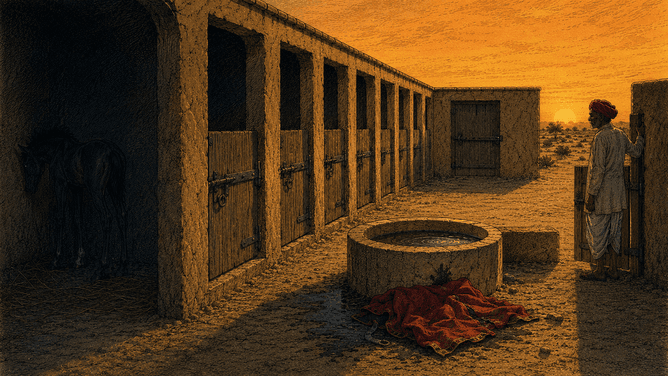
"But he was in a hurry. A man in a hurry stops thinking. And a man who has stopped thinking picks up the whip." Kishan Singh stopped and rubbed his closed eye with his thumb.
"The first cut fell across her left shoulder," he said. "She did not understand. That is the part you must hear properly, boy. She did not know what she had done wrong, so she could not stop doing it. She only knew that a person she trusted was hurting her, and she could not think of any way to make it end.
"So she did the one thing she could think of. She pressed herself against the wall, and she stood still, and she took it.
"I was at the well outside. I heard three sounds. Three. By the time I got back through that gate the blanket was lying in the dirt, and the filly had pushed her face into the corner of the wall the way a small child hides, as if not seeing a thing could make the thing go away.
"I took the whip out of his hand. I broke the handle on my knee. I put Ganga Ram out of that gate and told him what would happen to him if I saw him in Sarnau again.
"But I was too late, and that is a thing I will carry.
"She did not eat that night. She did not eat the next day either. She stood with her head over her door and her ears going this way, that way, this way, watching down the row of stalls.
She was waiting for somebody to come and tell her what she had done wrong, so that she would know never to do it again.
"Nobody came. Nobody could. Nobody in this village speaks her language.
"The cut healed in twenty days. The hair grew back grey, and grey it will stay. But the thing that broke in her that afternoon has not grown back at all. Even now, if a hand comes near that left shoulder, she is one year old again, and it is that same afternoon again, and there is still nobody coming to help her."
Kishan Singh got up.
"Six stable hands have tried her since. All six went home limping. So the bar stays across the door." Nathu did not say anything. He went back to the crack in the planks and put his eye against it. Bijli was standing exactly where she had been standing before, black and still, in the dark.
"I would have told her," he said.
"Told her what?"
"That she did nothing wrong."
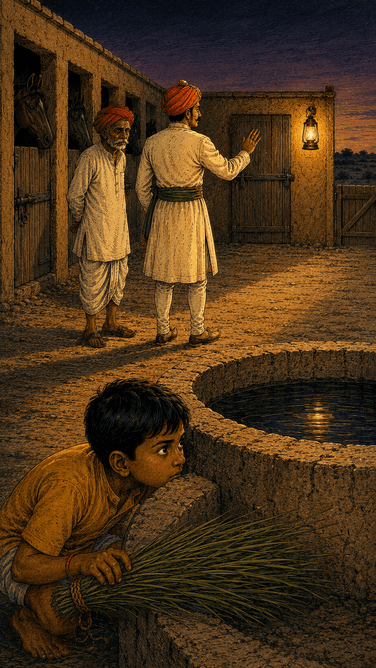
That evening the Thakur himself came to the stable. Nathu was sweeping up the loose grass, so he made himself small behind the water trough and did not move. The Thakur stopped in front of the shut door.
"A horse nobody rides is only a hungry mouth," he said.
"Suraj Mal the trader passes through twice a year. He will come again before the cold season ends. Sell her to him."
"As you say," said Kishan Singh. But he said it very slowly.
The Thakur went away. Nathu stayed behind the trough with the broom in his hands and a cold feeling in his stomach. He knew what traders did with a mare that could not be ridden. They put her in front of a cart. They loaded the cart with stones. They kept loading it until her legs gave way.
The next morning Nathu cut his own small bundle in the dark, as usual. But he did not eat his breakfast, and he did not wait for his father, and he ran the whole way to the stable.
Kishan Singh had left the top half of the last door open to give her air.
Bijli’s head came out. Her ears went flat back against her neck. She showed him two rows of long yellow teeth.
Nathu’s legs wanted to run. He made them sit down instead, on the low wall in front of the stall.
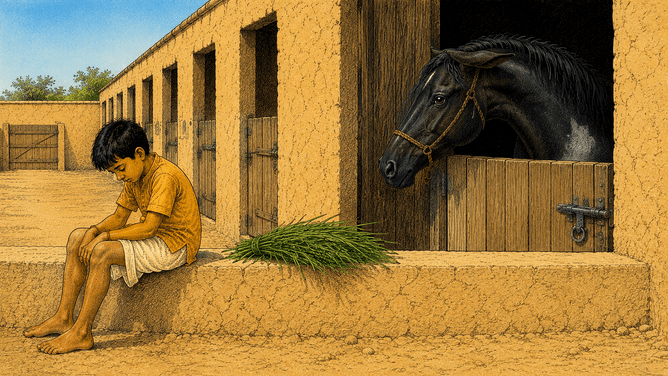
He did not look at her. He looked at his own dusty toes. Very slowly, he put one handful of green grass on the wall beside him.
Then he waited.
Bijli did not take it. She stood with her ears flat and watched him the whole time. Nathu counted to two hundred, and then he got up and went home, and the grass stayed where it was. He came back the next morning with a fresh bundle. He put the grass on the wall, and looked at his toes, and counted to two hundred.
He came the morning after that. And the morning after that.
On the seventh morning, something happened.
Nathu had just finished counting. He was already lifting himself off the wall. Then he heard a sound like a rope dragging over wood, and he turned his head one inch, and Bijli’s neck was stretched right out over the door. Her lips came down onto the wall. They felt about among the grass. They were soft and grey and they moved like two fingers. She took the whole handful and pulled her head back into the dark, and he heard her chewing. Nathu did not say one word. He walked out of that stable with his heart banging like a drum at a wedding.
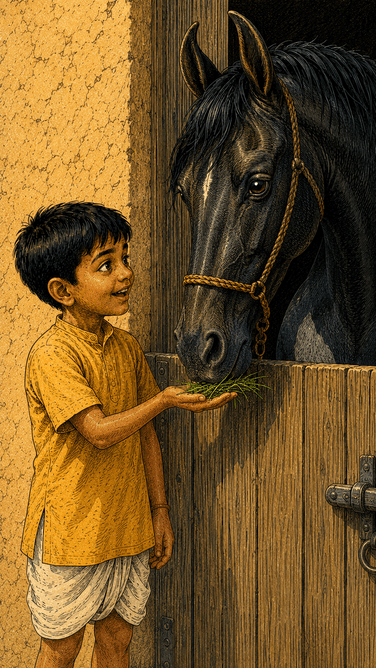
Three mornings later he did not put the grass on the wall. He held it out in his open hand. Bijli looked at the hand. She looked at the boy. Then she stretched down and took the grass, and her lips tickled his palm so much that he laughed out loud.
Her head shot up. Her ears went flat. She backed away into the dark of the stall, stamping her white foot.
So Nathu learned his first lesson, and he learned it standing perfectly still with grass in his hand: never laugh suddenly near a frightened horse.
Kishan Singh had been watching all of this from the far end of the row, saying nothing, for eleven days. On the twelfth morning he came down the row with a rope halter in his hand.
"Somebody has to clean that stall," he said, "and I am too old to fight her for it. You will bring her out to the trough while I clean. You will hold this rope. You will not pull on it, whatever happens. Can you do that?"
Nathu could not speak, so he nodded.
That was how Bijli came out into the morning yard for the first time in three years, walking beside a nine-year-old boy who was holding a rope he had been told not to pull. She drank at the trough for a long time. Then she stood in the sun with her eyes half shut while Nathu talked to her about the fields, and the well, and his sister’s crooked tooth. The accident happened on the fourth day of the cleaning.
Nathu was standing at her right shoulder, still talking. He wanted to see whether the trough needed filling, so he walked forward past her nose, round to her other side, and came back along her body without thinking about it at all.
He came up on her left shoulder. Bijli went straight up. Her forelegs came off the ground, and one hoof struck the trough so hard that the water jumped out of it in a sheet. The rope tore out of Nathu’s fingers. He sat down backwards in the wet sand.
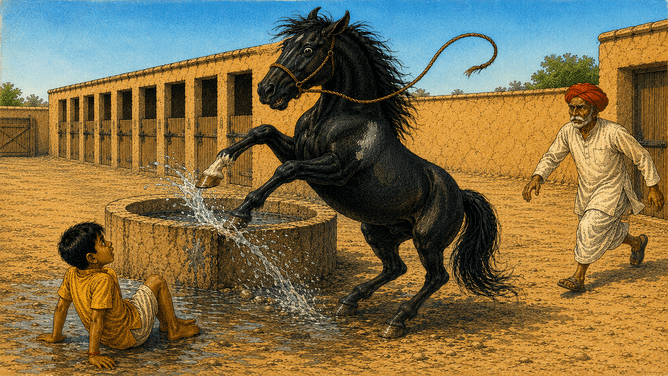
Kishan Singh came running with a stick in his hand. "Out! Out of my stable!"
"She was not angry with me," said Nathu from the ground.
"She nearly broke your head."
"She was afraid of the side where the whip fell."
The old man stopped with his mouth open. Then he shut it. He looked at the stick as though he could not remember picking it up, and he threw it away, and it clattered against the wall.
"Then be clever about it," he said, and walked off.
So Nathu made a game, and it was the slowest game in the world.
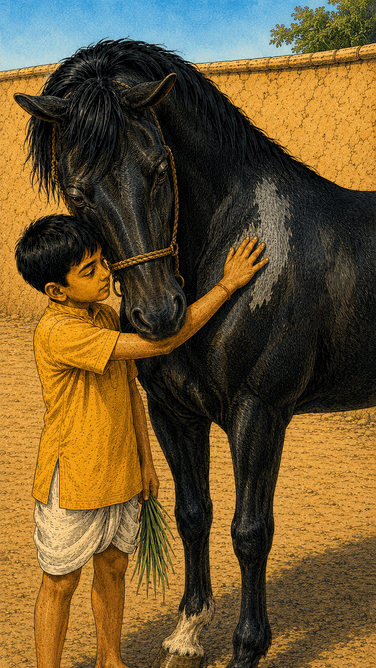
Every morning, out in the open yard, he stood at Bijli’s right shoulder with grass in his hand. Every morning he moved himself one hand’s width further to the left.
On some mornings her head came up and her eye showed white. On those mornings Nathu stood absolutely still, and let her look at him for as long as she wanted, and said nothing at all. When her head came down again, she got the grass. On the fourth day he was standing at her chest. On the eighth day he was at her neck. On the eleventh day he was standing beside her grey shoulder. He lifted his hand very slowly, and he laid his fingers on the grey patch, and he scratched it.
Bijli did not go up. Bijli leaned into his hand and half closed her eyes. That was the day Nathu climbed onto the low wall of the trough and slid onto her back. The world went sideways. There was a smell of sand, then a bang, and then Nathu was lying flat on his back looking up at a sky that was turning around like a wheel. Kishan Singh arrived at a run.
"Fool!"
Nathu sat up. His elbow was bleeding and full of grit. He looked for Bijli, and Bijli had not gone anywhere. She was standing three steps away with her ears pricked forward, watching him carefully.
"She let me sit," Nathu said. "She only did not know how to carry me."
Kishan Singh looked at the boy. Then he looked at the mare. Then he pulled his moustache for a long moment.
"Get up," he said. "If you are going to fall off a horse, at least learn to fall off her properly. Come behind the stable at sunset, when the Thakur is at his dinner."
The lessons happened on the soft sand near the thorn hedge, in the last orange light of the day.
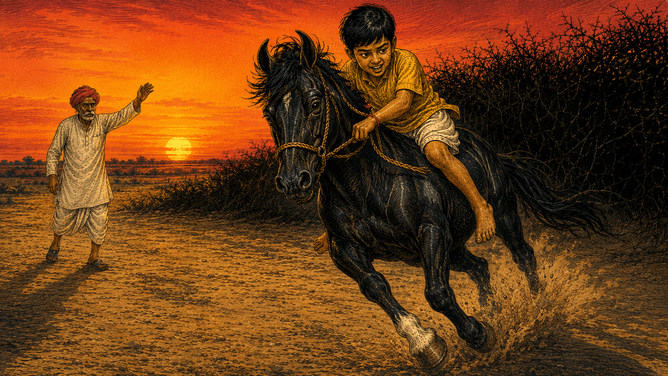
"Heels down," said Kishan Singh. "Push them down as if you are standing in deep water."
Nathu pushed his heels down. Bijli walked. Bijli turned. Nathu went over her shoulder and landed in the sand.
"Heels down."
He fell four times that first evening. He fell three times the next. On the third evening Bijli turned sharply near the hedge, and Nathu’s heels were down, and he stayed on, and his mouth opened by itself into a grin.
"Now your eyes," said the old man. "A horse goes where your eyes go. Look at the well."
Nathu looked at the well. Bijli walked to the well. He had not touched the rope at all.
"And the last thing is your breath. Breathe slowly. If you are frightened, she will believe there is something to be frightened of, and she will believe it faster than you do."
By the end of the cold season they were going out past the thorn hedge at a canter. The wind pulled tears sideways out of Nathu’s eyes. Bijli’s curved ears pointed straight ahead at the whole open desert, and her hooves made a sound like somebody beating a soft drum in an empty room.
Then Suraj Mal came. He arrived in the middle of the morning with two servants, a bag of coins, and a whip pushed through his belt. The Thakur brought him into the yard.
"Black," said the Thakur. "Four years old. Faster than anything in this district. But nobody can ride her, so the price is low."
"She can be ridden," said Nathu.
Everybody turned around. The grass-cutter’s son was standing at the gate with an empty rope in his hands.
The Thakur was a fair man. "Show me," he said.
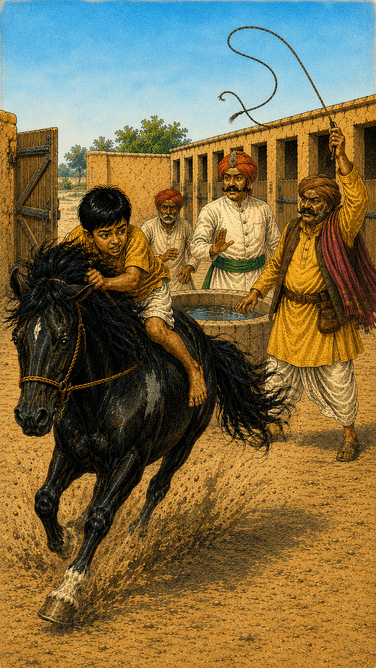
Nathu brought her out. He came up on her right shoulder, said something into her ear that nobody else heard, and swung onto her back. He rode her once around the yard at a walk. He rode her twice at a trot. One of the servants began to laugh in pure surprise.
Suraj Mal did not laugh. He was thinking about money. A mare that a child could ride was worth three times a mare that nobody could ride, and the price would climb the moment the Thakur understood that. So he pulled the whip out of his belt and cracked it in the air, once, on Bijli’s left side. The sound went through the mare the way lightning goes through a tree.
For one moment she was not four years old in her own yard. She was one year old, and pressed against a wall, and nobody was coming. She bolted.
She was out through the open gate before anyone could shout. She went down the slope on the far side, and Nathu saw where she was heading, and his whole body turned cold. Ahead of them lay the ravine — loose stones, dry thorn, and a drop the height of two men.
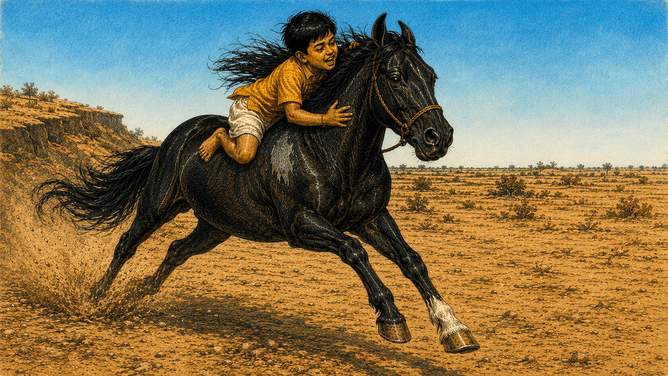
Everything inside Nathu screamed at him to pull back with all his strength. He did not pull. He knew what happens when a hand fights a frightened horse. She only runs harder. So he pushed his heels down until his legs ached. He leaned forward until his cheek was lying in her mane. He put his flat hand on her neck, in the same place he had scratched a hundred times on a hundred quiet mornings. And he began to sing. It was the grass-cutting song his father sang at dawn. It came out shaky and small. But it came out slow. One black ear turned back to listen. Nathu did not look at the ravine. He turned his eyes away to the right, out over the wide flat field, and he held them there. Bijli swung right.
He looked further along the curve of the field, and she followed his eyes, and the curve became a great circle. The circle became a smaller circle. The gallop became a canter. The canter became a bumpy, blowing trot.
She walked back in through the gate with the boy still on her back, her sides going in and out like a blacksmith’s bellows. Nobody said anything for a moment.
Then Suraj Mal cleared his throat. "I will pay double for that mare."
"She is not for sale," said the Thakur.
"Why not?"
The Thakur looked at Nathu, who had not yet let go of Bijli’s neck. "Because she is not mine to sell," he said. "For three years I owned her, and she carried nobody. This boy has never owned her for a single day.
She ran at that ravine with him, and she turned away from it with him, and she brought him home." Kishan Singh walked across the yard, took the whip out of Suraj Mal’s hand, and broke the handle on his knee, exactly as he had done once before.
"A horse is not broken," he said. "A horse is befriended. Every horseman in this village learned that today from a boy who cuts grass."
Nathu became the youngest rider in the Thakur’s stable. He was given a red turban that was much too big for him, and he wore it anyway. But he still went out at dawn with his father and the sickle. He still cut one small extra bundle in the dark before anybody else was awake. And that bundle, every single morning, went to the black mare with one white foot, before any other horse in that stable was fed. On winter mornings, when the mist lay low and thick over the fields, the people of Sarnau would see them going out towards the horizon — a small boy on a black mare, and two curved ears pointing the way, like two little hands about to clap.