
THE DEMON WHO DANCED
In the village of Rangapur, at the foot of the old blue hills, every child learned one rule before they learned to walk: never make music after dark.
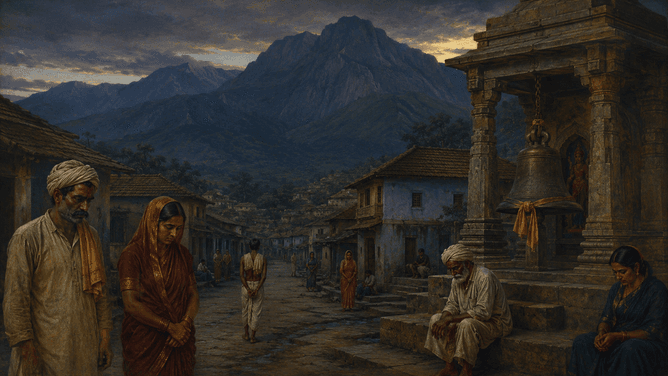
It was a strange rule for a village whose name meant “the place of colour and joy.” But Rangapur had been silent for sixty years.
Over time, the fear had grown so deep that the villagers stopped making music during the day, too. The temple bell wore a cloth tied around its tongue. Wedding processions moved through the lanes without a single note, the bride’s anklets stuffed with cotton. Old Bhola the drummer had buried his drums under the neem tree the way one buries the dead, and never spoke of them again. Even lullabies were hummed so softly that babies pressed their ears to their mothers’ hearts to hear them.
All because of Dhamak.
He lived somewhere high in the hills. No one had ever seen his cave, but everyone had heard his feet. If anyone forgot the rule — a boy whistling on his way home, a bangle-seller’s tray chiming in the dusk — the hills themselves would answer.
Dham.
Dham.
DHAM.
Each thud fell nearer than the last, until the lamps trembled in their niches and down he came: a demon taller than the tamarind tree, with shoulders like boulders and eyes like coals blown red. He would snap the flute over his knee. He would tear the strings from the veena. He would roar, in a voice that rattled the cooking pots, “NO MUSIC IN RANGAPUR!” — and climb back into the dark. In sixty years he had never harmed a single person. Only the music. But nobody ever stayed long enough to wonder about that.
Nobody except Malli.
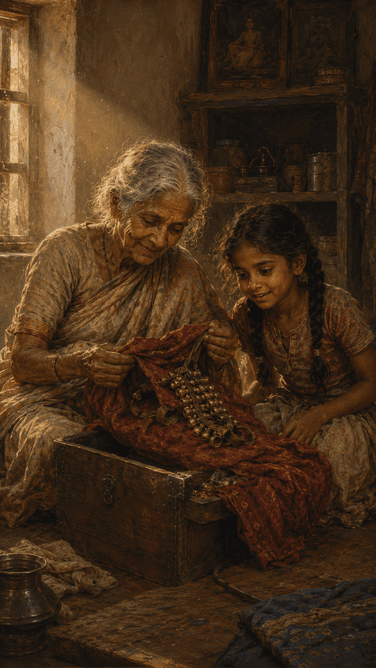
Malli was nine monsoons old, and she had a habit the elders found very troublesome: she asked questions. One damp afternoon, while helping her grandmother clean an old wooden trunk, she found a bundle of faded red cloth. Inside lay two leather straps sewn with a hundred tiny brass bells, dark with age.
“Ghungroos,” said Aaji softly, and her eyes went somewhere far away. “Dancing bells. Mine.”
“Yours?” Malli stared. Her grandmother’s knees complained every time she stood up to make tea. “Before you were born, Rangapur danced.
Oh, how we danced! On festival nights in Shravan we floated lamps down the river, the drums spoke till dawn, and even the crows kept the beat.” Aaji’s face dimmed like a lamp running low on oil. “Then Dhamak came down from the hills, and the music ended.”
“Why does he hate music so much?”
Aaji was quiet for a long moment. “Everyone says hate,” she said at last. “But I have heard hate, child, and his roar does not sound like it. It sounds like something else. In all these years, I have never found the word.” Malli looked at the little bells for a long time. Then she asked her most troublesome question yet.
“Aaji — will you teach me?”
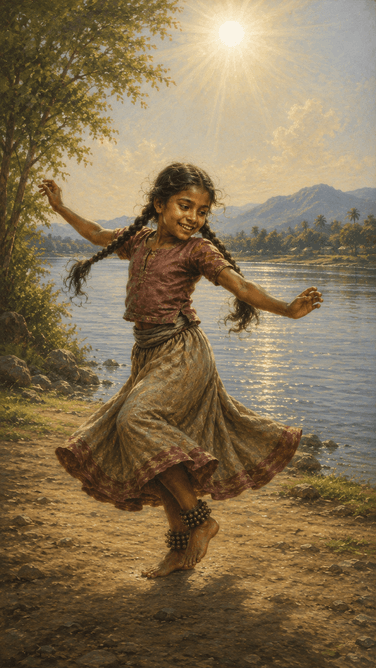
So they began, in secret. Aaji’s dancing days were behind her, but her hands remembered every beat, and she clapped while Malli’s feet learned. Every afternoon Malli slipped down to the riverbank — at noon, when the sun stood highest and demons are known to sleep — tied on the ghungroos, and practiced. Her turns wobbled. Her rhythm stumbled like a newborn calf. But her feet grew surer each day, and the bells grew brighter with them. Then came the evening she forgot the sun.
It happens to every dancer once. The river turned gold, then grey, then silver, and Malli, lost inside the dance, never noticed. When at last she stopped, breathless and laughing, the first star was out — and a hundred brass bells were ringing in the dark.
The laugh died in her throat.
Dham.
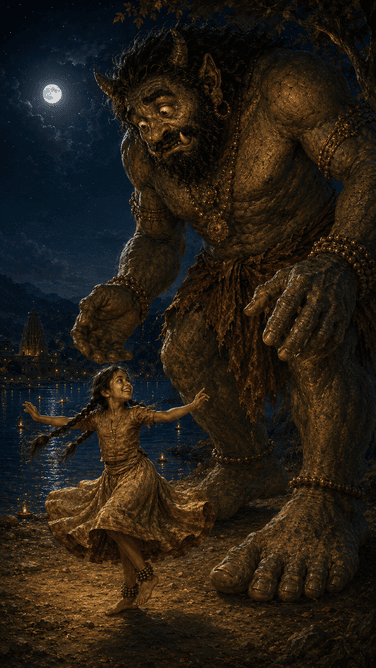
Her legs turned to water. Dham. Birds burst from the trees. DHAM. And there he stood, blotting out the stars, ember eyes glowing down at the small girl by the river.
Malli’s fingers shook so badly she could barely untie the ghungroos. She held them out at arm’s length — take them, break them, only go — and as she did, one little bell chimed.
Now, Malli noticed things. Even terrified, she noticed two things.
At that tiny sound, the demon’s face did not twist with rage. It flinched — the way a face flinches at an old wound. And down in the river mud, his enormous cracked toes were tapping. Once. Twice. Keeping time with a music that had stopped.
For sixty years, people had screamed at Dhamak. In all that time, no one had looked closely enough to see the truth.
“You’re keeping time,” said Malli, in a voice as small as the bell. “You’re a dancer, aren’t you?”
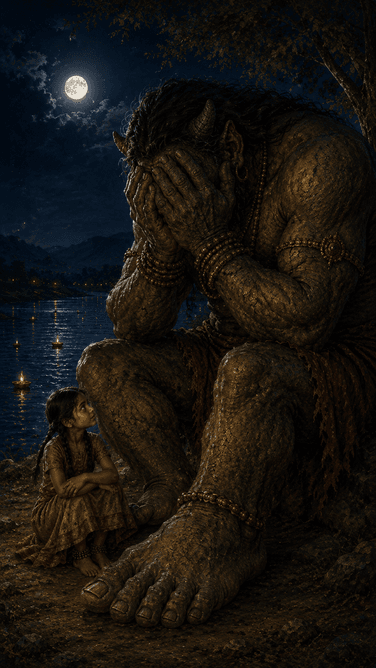
The demon staggered as though she had struck him. Then, slowly, he sat down — the riverbank shuddered — put his terrible face in his terrible hands and told her.
“Long before your grandmother was your size,” he said, in a voice like stones grinding, “my name was Anand, and I was the greatest dancer in the kingdom. When I danced, kings forgot their thrones. Flowers were thrown until my feet disappeared beneath them. And I knew I was the greatest. That was the poison, little one. I knew.” One festival night at the temple, an old man with a crooked leg had joined the dancing out of turn — clumsy, hopping, shining with joy. And Anand, the great Anand, had mocked him before the whole crowd, copying that limp step for step until everyone wept with laughter.
The old man was a sage.
“‘You dance for pride, not for joy,’” the demon whispered, “‘so lose them both. Let your grace turn to heaviness and your beauty to terror. Let every note of music burn your ears like embers, you who made music your servant. And so remain — until someone who knows exactly what you are dances for you. For you alone. With joy, and without fear.’”
He looked down at his huge hands. “Who would ever dance for a monster? So I made sure no one danced at all. Breaking flutes, little one, hurts less than hearing them.”
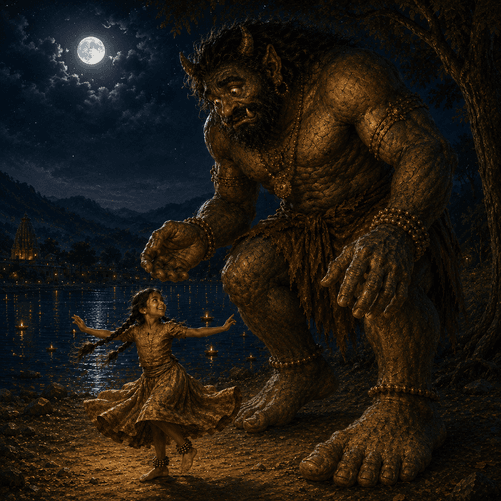
Malli sat very still. So that was the word Aaji could never find, she thought. Not hate. Grief.
Then she did the bravest thing ever done in Rangapur. She tied the ghungroos back on.
“Child—” The demon started up in alarm. “The music burns—”
“It burns,” said Malli, “because it was never for you. This one is.”
And she danced.
It was not a great dance. Her turns still wobbled. She lost the beat, found it again, and laughed at herself out loud. But she danced looking straight into those ember eyes, and she danced smiling, and every chime of every little bell said the same thing over and over: this is for you, this is for you, this is for you.
The demon braced himself for the burning.
It never came. The sound fell on him like the first rain on cracked earth.
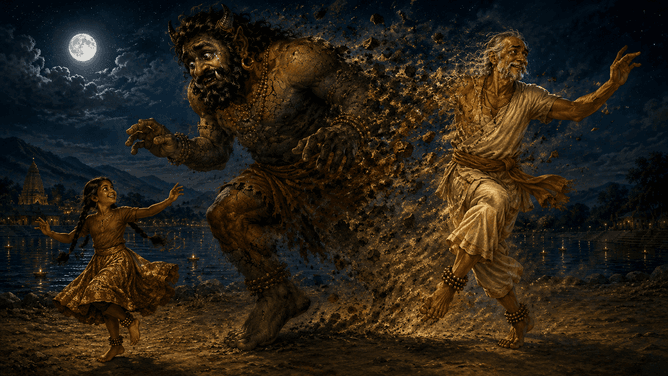
His great foot moved before he could stop it. Then the other. He rose to his full height — and the demon danced. The riverbank became his drum. Dham, dham, dham rolled his footsteps, the same dreadful sound that had emptied the lanes of Rangapur for sixty years, only now it kept perfect, joyful time beneath the bright chatter of Malli’s bells. He danced with tears streaming down his face, and every tear that fell seemed to carry something away with it. The boulders melted from his shoulders. The coals of his eyes cooled to a warm, wet brown. He grew smaller, lighter, straighter — until, as the last bell faded, there stood in the moonlight an old man with silver hair, upright as a lamp flame, on the light feet of a dancer.
He listened to the silence for a long time. “It doesn’t burn,” he whispered. “Little one. It doesn’t burn.”
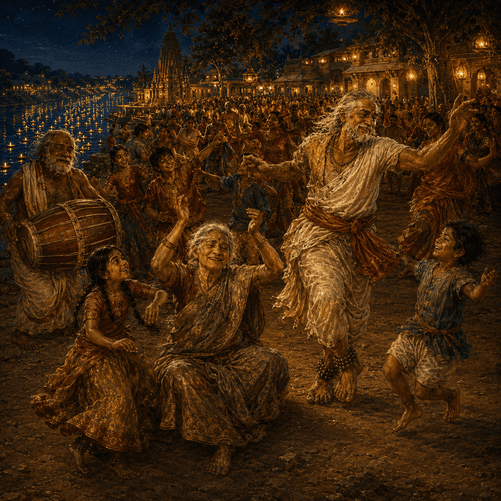
There is not much more to tell, for happiness makes a short story. The village panicked in the morning, then wondered, then wept. Old Bhola dug up his drums from under the neem tree, where they had slept safe in waxed cloth all those years. The rag was untied from the temple bell’s tongue. And when the month of Shravan came, lamps floated down the river once more while all of Rangapur danced till dawn — badly, beautifully — Aaji dancing too, in her own way, seated, with her hands.
As for Anand, he never left. He lives there still, they say, in a small house by the village square, where he teaches the children to dance — and he is kindest of all to the clumsy ones. So if you ever pass through Rangapur on a festival night, you will hear it rolling out to meet you: dham, dham, dham — the big drum, keeping everyone honest. The little children stop when they hear it. Then they run — not away, but toward it. Because everyone in Rangapur knows what Malli learned by the river: that anger is often only sorrow with nowhere to go, and that one small gift, given with the whole heart, can turn it back into music.