
THE WHISPERING TREE
Long ago, at the eastern edge of the village of Nimgaon, there stood an old tamarind tree. It was older than anyone’s grandmother’s grandmother. Its trunk was as wide as a bullock cart, its bark was grey as ash, and its pods rattled even when there was no wind.
Every evening, when the cows came home and the sky turned orange, the tree began to whisper. Not the whisper of leaves. Everyone knew the whisper of leaves. This was the whisper of voices. "Stay away from that tree after dark," the elders told the children.

"And never swallow a word near it. A word swallowed near the tamarind is never seen again."
Nobody explained what this meant. But then, the people of Nimgaon had always been strange about words. They used as few of them as possible. Rukmini the flower-seller had not spoken to her brother in nineteen years, though their houses shared a wall. The schoolmaster wrote his scoldings on a slate instead of saying them out loud. Even small children learned to bite back the words that rose to their tongues. In Nimgaon, words felt heavy, like stones under the tongue, and it was always easier to swallow them.
Only one person in the whole village was different.
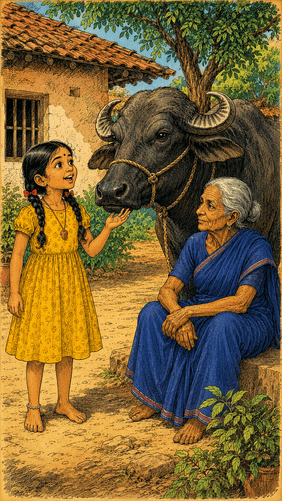
Malli, the drummer’s daughter, was nine years old, and she talked from morning till night. She talked to the buffaloes. She talked to the well-rope. She talked to the rain. She lived with her grandmother, her Aaji, who spoke barely ten words a day and kept the rest somewhere behind her eyes.
"Words are not sparrows, Malli," Aaji said once, watching her chatter at a crow. "A word that flies out — let it fly, no harm done. But a word you swallow…" She stopped, looked east toward the tamarind, and said nothing more.
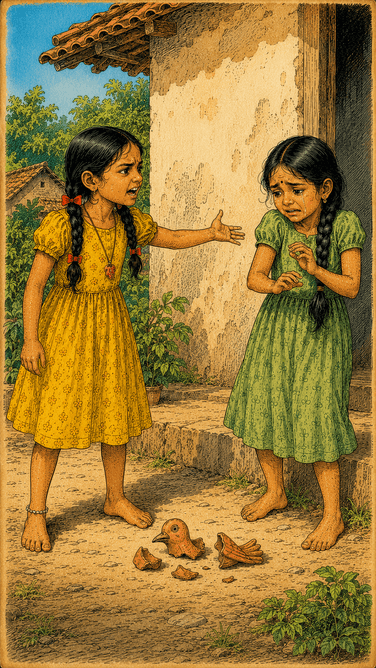
That summer, Malli quarreled with her best friend.
It happened over a small thing, the way big quarrels often do. Devi, the cowherd’s daughter, picked up the clay sparrow that Malli’s father had made for her.
It slipped from her hands and broke into three pieces on the doorstep.
"You break everything!" Malli shouted. "No wonder they call you clumsy-foot!"
Devi’s face crumpled. She turned and ran. By evening, Malli’s anger was gone, and shame had taken its place.
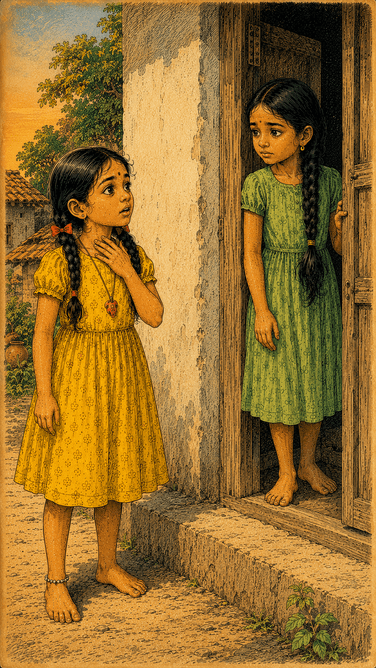
She walked to Devi’s house with the apology ready on her tongue, round and whole as a ripe plum. Devi opened the door. Malli opened her mouth.
And she swallowed it.
She felt it go down — really felt it, like a plum-stone sliding down her throat. Then her mouth was empty, the door was closing, and the moment was gone.
That night, a wind blew from the east, and the tamarind whispered louder than anyone had ever heard it.
In the morning, Malli went back to Devi’s house, determined to say sorry properly. But the words were not there.
She could say "buffalo". She could say "monsoon". She could recite her seven-times table without one mistake. But when she reached for "I’m sorry, Devi," her tongue found only an empty gap — the way it finds the place where a tooth has fallen out. The words were gone, as if they had never been hers at all.
She stood on the doorstep, opening and closing her mouth, until Devi finally shut the door with a hurt look. Malli spent the rest of the afternoon wandering the fields, weighed down by a silence she didn’t understand. She might never have known what had happened, if she had not walked home past the tree at sunset.
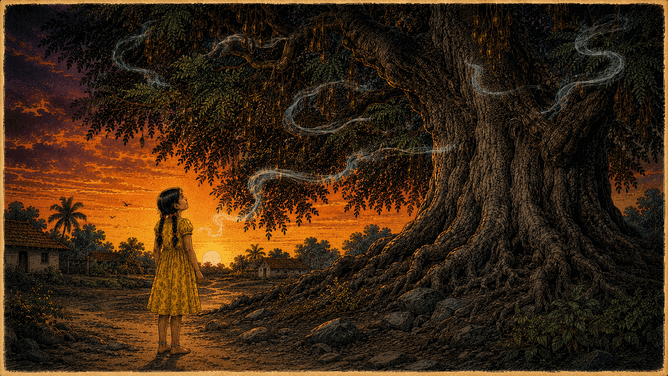
The tamarind was whispering. And woven in among its hundred soft voices was one small voice she knew very well. Her own.
…I’m sorry, Devi… I’m sorry, Devi… I’m sorry…
Malli stood frozen until the temple bell rang. Then she ran all the way home and told Aaji everything.
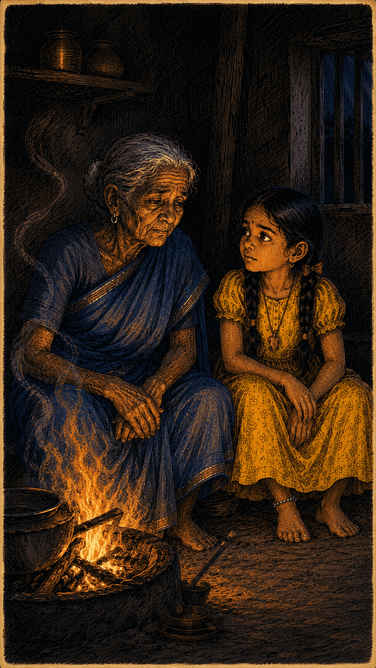
Aaji sat very still and looked into the cooking fire for a long time. When she finally spoke, her voice was rusty, like a door that is rarely opened. "So it has taken from you too."
"Taken what, Aaji? Who?"
"That tree keeps every word this village has ever swallowed," said Aaji. "Every sorry.
Every stay.
Every I-was-wrong and every I-love-you that reached the teeth and turned back. That is what whispers in its leaves, child. A hundred years of swallowed words." She paused.
Her hands tightened in her lap. "Forty years ago, my sister Yamuna stood at that very door with her bundle on her shoulder. We had quarreled over — pah, I don’t even remember what. One word from me, and she would have put the bundle down. One word. Stay." Aaji’s eyes shone in the firelight. "I swallowed it. She walked to the crossroads and out of my life. And on some evenings, Malli, when the wind blows from the east, I hear a young woman’s voice in that tree saying stay, stay, stay. It is mine."
"Then I will go and take my word back," said Malli.
"You will not," said Aaji. "The tree has a keeper."
But Malli was nine, and sorry, and stubborn — and that is a powerful mixture.
The next evening, when the cows were coming home, Malli walked past the dry well and stood under the tamarind. Up close, the whispering was frightening and beautiful at the same time. Voices rose and fell all around her: forgive me… don’t go… it was my fault… you sing so well… take my share… come home… All the kind things the village had never said, murmuring on and on in the dark leaves. It was, Malli thought, the saddest treasure in the world.
"Give me back my word," she said loudly. "It’s mine."
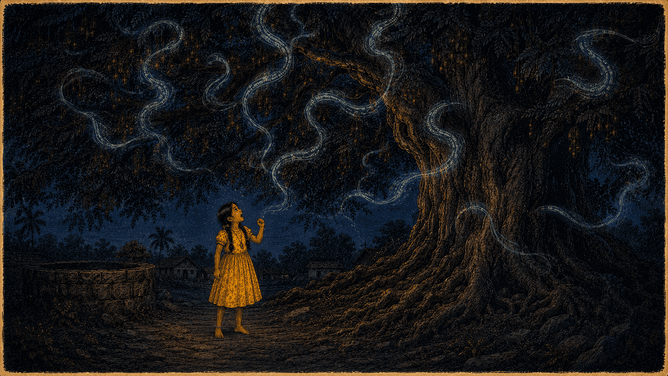
The bark moved.
It did not crack. It opened softly, like a curtain, and out stepped a woman as tall as the lowest branch. Her hair hung in long grey twists, like roots. Her skin was the grey-brown of the trunk. Her sari was the colour of dead leaves, and when she moved, she rattled softly, like dry pods. Her eyes were the strangest part of her — dark and shiny as tamarind seeds, and old, old, old.
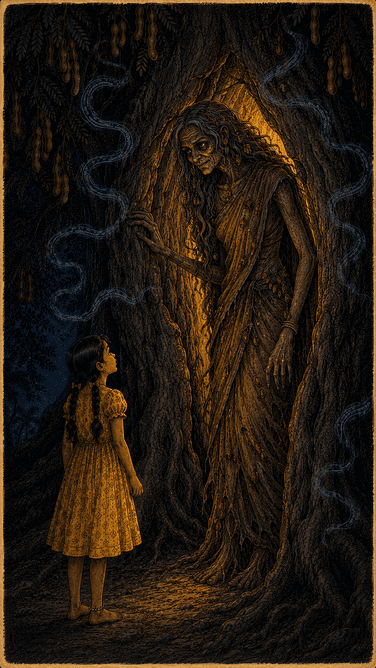
"Yours?" said the witch. Her voice was thin and dry, like wind through a crack in the door. "Nothing here belongs to anyone. A swallowed word is a wasted word, and whatever is wasted comes to me. That is the law. I did not make it. Your village made it, one swallowed word at a time."
"Then I’ll trade you for it," said Malli, her heart thumping, but her feet staying put. "My clay whistle. My silver anklet. I’ll sweep under your tree every Sunday for a year."
The witch laughed — a sound like pods shaken in a tin. "Child, I own ten thousand of the most precious things in the world." She spread her long fingers toward the whispering dark. "What do I want with trinkets? I keep only what people fail to give each other."
And then Malli did the thing that changed everything. Not because it was clever. Simply because she was Malli, who talked to buffaloes and well-ropes and rain, and it was her nature.
She asked, "What is your name?"
The whispering stopped.
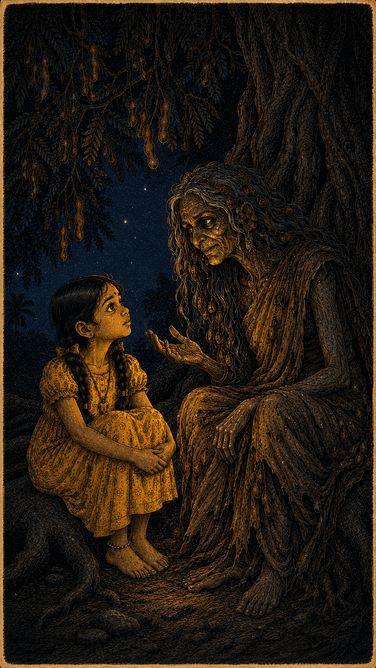
For the first time in a hundred years, the tamarind stood completely silent. The witch stared down at the small girl as if the ground itself had spoken.
"No one," she said at last, and her dry voice trembled, "has asked me that since I wore flowers in my hair." "Well," said Malli, "I’m asking." "…Kalindi. My name was Kalindi."
Then Malli sat down on a root, wrapped her arms around her knees, and waited the way one waits for a story. And Kalindi told her.
Long ago, she had been the ferryman’s daughter — a girl with a slow, stumbling tongue. Words came to her like shy fish. You had to be patient with them. Nobody was. The year the headman’s granary burned down, Kalindi had seen who dropped the lamp. She had seen it with her own two eyes. She stood before the whole village with the truth ready in her mouth. But her tongue stumbled, the crowd grew restless, and before her words could swim free, the headman turned away and said, "The girl has nothing to say."

Her father lost the ferry. Her family left the village in shame. And when Kalindi was old, she came back and lay down under this tamarind with a whole life of unsaid words still inside her. Grief, when it grows old enough, turns into something else. Hers turned into roots. My sorrow anchored me here, and your swallowed words fed those roots. That is the law. I did not make it on my own. Your village built it with me, one swallowed word at a time.
"You people had voices," she finished, "and you wasted them. You swallowed them as if they cost nothing. So I gathered what you threw away. Why not? No one ever gave me a word. Not one. Not in my whole life." The first stars were out. Malli had listened to every word without interrupting once — which, for Malli, was its own kind of magic.
Then she stood up, looked into those tamarind-seed eyes, and said – "I’m sorry, Kalindi. I’m sorry nobody waited for your words. They were worth waiting for."
She did not trade the apology. She did not bargain with it. She gave it. And a given word is the one thing a keeper of swallowed words cannot take. She can only receive it.
Kalindi’s hand flew to her chest, as if something warm had touched her there. The tree shook from its roots to its crown.

All along the grey branches, the old pods burst open at once — and out of them poured not seeds, but moths. Thousands of pale moths, each one carrying a whisper, rose over Nimgaon like white petals floating up instead of down.
The swallowed words were going home.In her lamplit kitchen, Rukmini the flower-seller felt something soft land on her lips. She stood up in the middle of her supper, walked to the wall she shared with her brother, and said his name for the first time in nineteen years. The schoolmaster, checking slates, suddenly laughed out loud — nobody ever found out at what. All over the village, doors opened. Rusty voices tried themselves out in the dark. And in one small house, an old woman felt forty years of stay come home to her. Being wise, she did not say it. It was too late for stay. She stood in her doorway and gave the night a better word instead: "Come back." Far away, in a village by another river — believe this part or not, as you please — an old woman named Yamuna woke before dawn, thinking of her sister. And for no reason she could name, she began to pack a bundle.
Under the tamarind, Kalindi was changing. The grey faded from her like mist in the morning sun. She looked down at her empty hands — empty for the first time in a hundred years — and smiled. It was a young girl’s smile.
"So that is what it feels like," she said softly, "to be given one." "Wait," said Malli. "Where will you go?"
But Kalindi had already stepped back into the bark, light as a breath, and the wooden curtain closed behind her. Where her fingers had touched the branches, buds appeared. That spring, for the first time in living memory, the old tamarind blossomed — small golden flowers from crown to root — and the whole tree hummed with honeybees instead of whispers. A pale moth found Malli on the path home. It landed on her lips, soft as a breath, and was gone. She felt the plum-stone rise, and her mouth was full again. She did not wait for morning. She ran through the dark to Devi’s door and knocked until it opened.
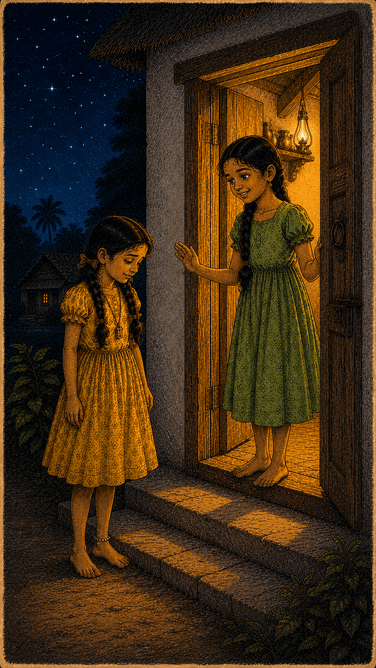
"I’m sorry," she said, all in one breath. "You don’t break everything. Your hands are just faster than the world, that’s all. And I’m sorry."
Devi stared at her for a moment. Then she grinned. "Come in, chatterbox. There’s kheer."
The tamarind still stands at the eastern edge of Nimgaon, and children still play under it, even at dusk. If you stand beneath it when the cows are coming home, you will hear only the ordinary rustling of leaves — which, the grandmothers say, is the sound of a village with nothing left unsaid.